


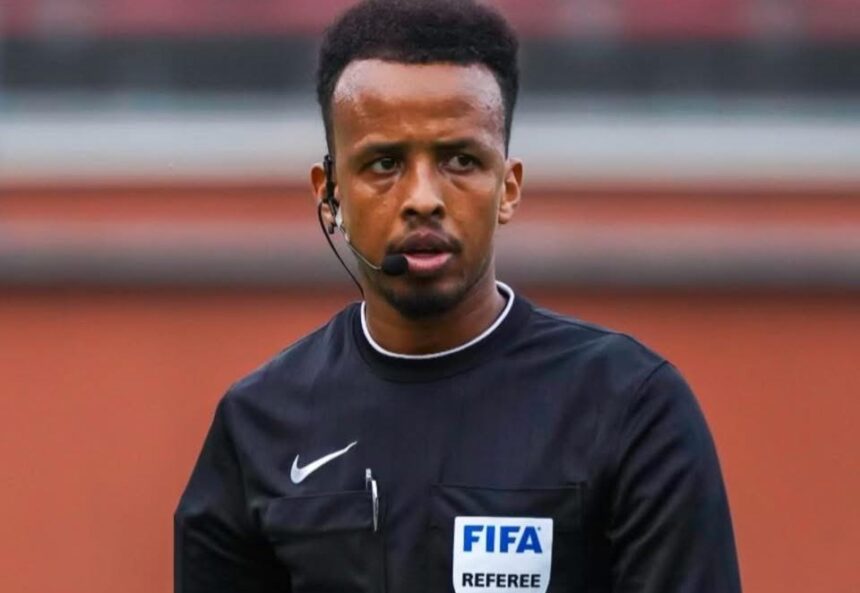
Fédération Internationale de Football Association(FIFA) has confirmed that Somali referee Omar Artan will not officiate at the 2026 FIFA World Cup after being denied entry into the United States.
The world football governing body announced on Monday that Artan, who had been selected among the officials for the tournament, would be unable to participate after US authorities refused him entry upon arrival in Miami.
In a statement, FIFA said: “FIFA can confirm that match official Omar Abdulkadir Artan will be unable to train and officiate at the FIFA World Cup 2026 after he was denied entry into the United States.
“FIFA is not involved in host country immigration processes, including visa adjudications, and has been informed by authorities that Mr Artan’s status will not be changed at present.”
Artan’s absence is a significant setback for the referee, who was set to become the first Somali official to referee at a FIFA World Cup final. The 38-year-old has emerged as one of Africa’s most respected match officials in recent years, officiating at the Africa Cup of Nations and other major international competitions since becoming a FIFA-listed referee in 2018.
According to reports, Artan arrived in Miami ahead of the tournament but was subjected to an 11-hour immigration interview before being denied entry and returned to Turkey. US authorities have not publicly disclosed the reason for the decision.
The incident has attracted attention because Somalia is among the countries affected by travel restrictions introduced by the administration of US President Donald Trump.
Somali officials have stated that Artan was travelling with valid documents, including a diplomatic passport issued to facilitate his travel after earlier visa challenges.
FIFA’s refereeing programme for the World Cup requires all selected officials to be based at a centralized training camp in Miami, where they undergo physical preparation, tactical briefings and match assignments throughout the tournament.
The training hub, established under the supervision of FIFA Referees Committee chairman Pierluigi Collina, will host 52 referees and 88 assistant referees during the competition.
Because all match officials are required to remain at the Florida base, Artan cannot officiate matches hosted in Canada or Mexico while remaining outside the United States.
The decision comes just days before the start of the expanded 48-team tournament, which runs from June 11 to July 19 across the United States, Canada and Mexico.
Speaking about the ordeal, Artan expressed disappointment at missing what would have been the biggest assignment of his career.
“I’m just simply a referee who’s trying to live his dream, the biggest dream of my life, to come to the World Cup,” he told The New York Times.
His withdrawal adds to a growing list of logistical and administrative challenges surrounding the tournament. Earlier this week, Iran’s football federation said its allocation of fan tickets for the group stage had been revoked, raising further concerns about access and travel arrangements ahead of the competition.
While FIFA has reiterated that immigration decisions remain the responsibility of host-country authorities, Artan’s exclusion has sparked debate over the impact of travel restrictions on participants at the world’s biggest football tournament.
The governing body has not announced whether a replacement official will be appointed to take Artan’s place on the World Cup refereeing roster.
CREDIT: MAVIS FANTEVI