


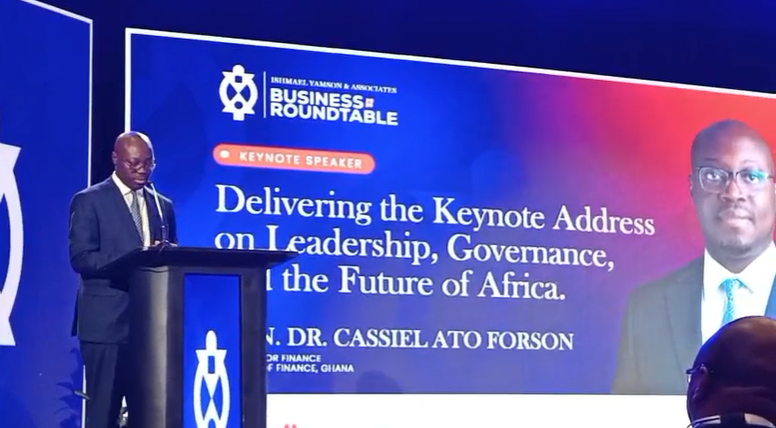
Ghana’s Finance Minister, Cassiel Ato Forson, has called for a bold rethinking of Africa’s development model, stressing that the continent’s next phase of growth will be driven by integrated infrastructure and digital sovereignty.
Delivering a keynote address on leadership, governance and the future of Africa on Thursday May 28, 2026 at Kempinski hotel, Accra, he said Africa’s transformation will depend on coordinated investment in commercial agriculture, energy, transport and logistics systems, as well as digital, financial, and human capital infrastructure.
He warned that without such integration, Africa’s ambitions for regional development would remain unrealised.
“The global economy is increasingly digital,” he noted, pointing to artificial intelligence, cloud computing, fintech, digital payments, e-commerce and data governance as the new drivers of competitiveness.
According to him, countries that control digital infrastructure and data ecosystems will shape the future of the global economy.
Ato Forson cautioned that Africa risks being left behind if it remains a passive consumer in the digital age, raising key sovereignty questions around ownership of digital infrastructure, data storage, payment systems, and fibre networks across the continent.
He therefore called for a continental digital strategy that prioritises regional data centres, affordable cloud infrastructure, expanded broadband access, cross-border payment systems, cybersecurity frameworks, and digital skills development for young people.
“The next global economic frontier will not simply be built with roads and ports, but with codes, connectivity, computation and innovation,” he said.
On Ghana’s digital agenda, he said the country is making progress under the leadership of President John Dramani Mahama, citing reforms in digital public infrastructure, fintech expansion, financial inclusion, and support for digital entrepreneurship.
On energy, he stressed that Africa cannot industrialize without reliable and affordable power, noting that over 600 million people on the continent still lack electricity, while power outages cost billions of dollars annually in losses.
He described this situation as unacceptable given Africa’s abundant energy resources, including gas, hydro, solar, wind, and critical minerals.
He further argued that the coming decades must define Africa’s “industrial century,” focusing not only on raw material extraction but on value addition, including refining lithium, producing aluminium, and processing cocoa into finished goods.
For Ghana, he said efforts are underway to expand installed generation capacity significantly, with a target of reaching 3,000 megawatts by 2030 as part of broader industrialisation efforts.
CREDIT: Mavis Fantevi