


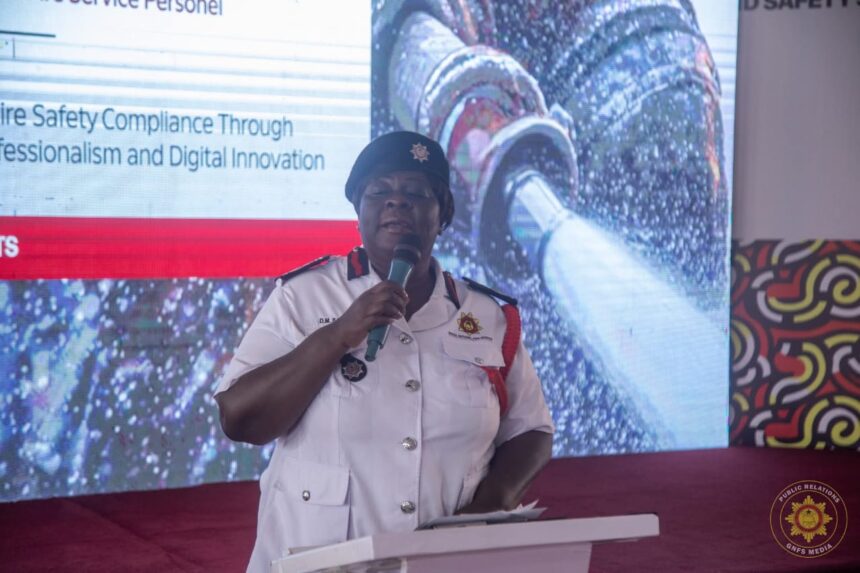
The Chief Fire Officer (CFO) of the Ghana National Fire Service (GNFS), Daniella Mawusi Ntow Sapong, has called on officers to take a leading role in promoting the Service’s new digital fire compliance system as part of efforts to modernise fire safety regulation in Ghana.
She made the call at the closing ceremony of a two-day capacity-building programme held at the Fire Academy and Training School (FATS) in James Town, Accra, where 983 officers drawn from five regional commands were trained on the Automated Fire Compliance and Safety System (AFCAS).

The officers came from the Ashanti, Western, Eastern, Northern, and Greater Accra Regional Commands. The training forms part of GNFS’s broader digital transformation agenda aimed at improving efficiency, transparency, and professionalism in fire safety compliance.
Addressing participants, the CFO congratulated both officers and facilitators for successfully completing the training and commended their commitment throughout the programme. She described the exercise as a key milestone in strengthening the Service’s operational systems through technology.

She urged participants to apply the knowledge gained and further train colleagues at the station level to ensure a smooth rollout of the AFCAS platform across all operational units. She also encouraged them to act as ambassadors of the system and promote its benefits within their respective commands.
The AFCAS platform is designed to streamline fire safety certification processes, improve compliance monitoring, reduce administrative delays, enhance transparency, and strengthen service delivery. It is expected to improve regulatory efficiency and make fire safety compliance more accessible and responsive.

The project will first be piloted in the five participating regional commands before a nationwide rollout.
The CFO stressed that the success of the system would depend not only on technology but also on the commitment of officers and cooperation from the public. She called for teamwork, professionalism, and innovation in enhancing fire safety compliance nationwide.
She also appealed to stakeholders and the general public to support the initiative, noting that sustained compliance and shared responsibility are essential in reducing preventable fire outbreaks and protecting lives and property.

“The successful implementation of AFCAS is a strategic step toward modernising fire safety administration. We are counting on officers and the public alike to support this innovation so that together we can prevent avoidable fires and protect lives and property,” she said.

CREDIT: MAVIS FANTEVI