


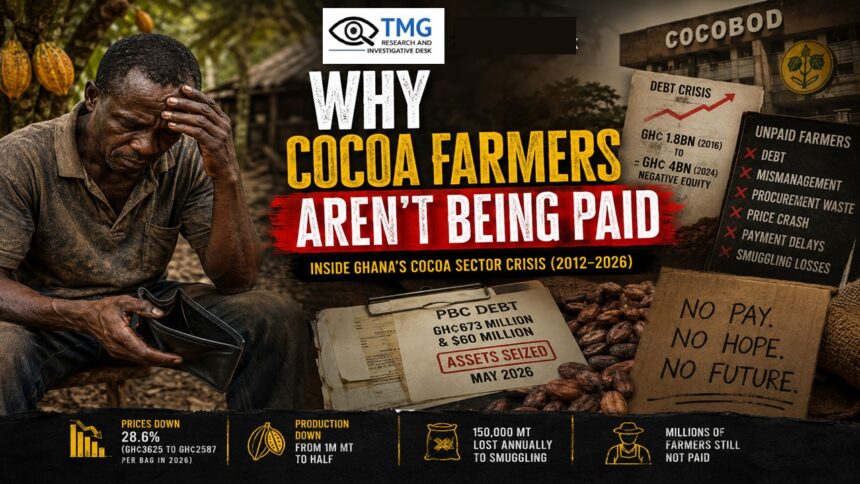
The reason cocoa farmers are not being paid is clear: a combination of crippling debt, mismanaged funds, inefficient procurement, and a broken payment system.
Ghana’s cocoa farmers are at the center of a deepening crisis, one marked by mounting debt, financial mismanagement, and systemic inefficiencies that have left many without payment for months.
A comprehensive analysis by the TMG Research and Investigative Desk reveals that the failure to pay farmers is not an isolated issue, but the result of years of structural problems within the cocoa sector.
Debt Crisis Choking Payments
At the core of the problem is the worsening financial position of the Ghana Cocoa Board (COCOBOD).
The report shows that COCOBOD’s debt, which ranged between GH₵1.8 billion and GH₵2.2 billion in 2016, deteriorated into nearly GH₵4 billion in negative equity by 2024.
This financial strain has significantly limited the institution’s ability to release funds consistently for cocoa purchases, directly affecting payments to farmers.
The situation escalated in 2024 when Ghana defaulted on its cocoa syndicated loan for the first time in 32 years, damaging investor confidence and restricting access to international financing that traditionally supports cocoa purchases.
Funds Diverted Away from Farmers
Between 2018 and 2021, about GH₵21.5 billion was spent on cocoa road contracts, far exceeding COCOBOD’s operational budget.
These expenditures, the report notes, diverted critical resources away from farmer payments and productivity support.
Additionally, a total of GH₵26 billion was committed to cocoa road infrastructure, creating a massive financial burden. Efforts to restructure this debt were unsuccessful, leaving COCOBOD with limited liquidity.
Procurement Failures and Waste
The crisis has also been worsened by questionable procurement decisions.
In 2024, COCOBOD spent $48 million on jute sacks despite over 150,000 bales already sitting idle at ports, tying up funds that could have been used to pay farmers.
At the same time, administrative expansion within the sector has increased costs, while investment in agronomic support has declined, leading to a sharp drop in cocoa production.
Output has fallen from about one million metric tonnes in the 2020/2021 season to nearly half that level in subsequent years, reducing revenue inflows needed to sustain payments.
Market Pressures and Institutional Debt
Global and domestic market pressures have compounded the crisis.
Cocoa producer prices dropped by 28.6 percent, from GH₵3,625 to GH₵2,587 per bag in 2026, while global prices fell from around $8,000 to $4,000 per tonne.
Meanwhile, the Produce Buying Company (PBC), a key state-owned buyer, is heavily indebted, owing GH₵673 million and $60 million. Its assets were seized in May 2026, further disrupting the payment chain.
This breakdown means that even when funds are released, they do not always reach farmers.
Broken Payment Chain
Although COCOBOD disburses funds to Licensed Buying Companies (LBCs) and purchasing clerks, systemic inefficiencies have resulted in delays and non-payment at the farmer level.
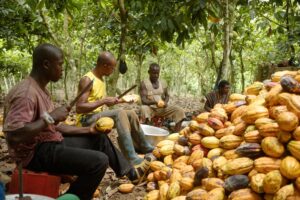
Many farmers are left waiting, forcing them to rely on high-interest moneylenders or turn to alternative livelihoods, including illegal mining.
Cocoa smuggling is also on the rise, with an estimated 150,000 metric tonnes lost annually, further draining the sector’s revenue base.
Are Farmers Really Better Off?
Despite the payment challenges, the report highlights some improvements in farmer earnings under recent policy adjustments.
As of early 2026, farmers earned about 23.6 percent more in dollar terms compared to previous periods, largely due to improved exchange rate conditions.
Inflation has also dropped significantly, from around 23 percent to about 3 percent, helping to preserve the real value of incomes.
Additionally, farmers reportedly received about 90 percent of the gross world price, compared to 63.9 percent in earlier years, suggesting better price transmission.
However, these gains are undermined by delayed or unpaid funds, meaning many farmers are unable to fully benefit.
What’s the Bottom Line here?
The reason cocoa farmers are not being paid is clear: a combination of crippling debt, mismanaged funds, inefficient procurement, and a broken payment system.
While some policy improvements have been made, they have not addressed the structural weaknesses at the heart of the sector.
Until COCOBOD’s finances are stabilized, spending is disciplined, and payment systems are reformed, farmers will continue to bear the brunt of a crisis they did not create.
For more in-depth investigations and data-driven reporting, follow the TMG Research and Investigative Desk.
For TMG Research and Investigative Desk, Maxwell Mensah, Lead.