


“How do I juggle family and work responsibilities? Will my family remain intact if I take up a leadership role abroad? Am I even qualified for this position?”
These are questions often associated with women navigating career advancement. Yet, when framed as concerns voiced by men, they sound unfamiliar, even unlikely. The contrast highlights a persistent reality: women continue to face unique internal and external barriers on the path to leadership.
According to the 2019 Women in Business and Management report by the International Labour Organization, women make up 50% of the global workforce but account for only 40% of total employment, and just 35% of management positions.
So why are women still underrepresented at the top?
To mark International Women’s Day this year, the Bank of Ghana Ladies Association hosted an event on Thursday, 16 April, bringing together women across Ghana’s financial sector to share ideas on how to strengthen female leadership pipelines.
Delivering the keynote address under the theme “Breaking barriers and building stronger female leadership pipelines,” Matilda Asante Asiedu, Second Deputy Governor of the Bank of Ghana, pointed to what she described as a “transition gap” that continues to hinder women’s progression to senior roles.
“While women are increasingly visible and impactful across the banking sector and other sectors, representation at the senior leadership level does not fully reflect the depth of talent available among women. This is not a pipeline problem, but a transitional one.
Women are not short of capabilities; we have a shortage of structured pathways to leadership at the top.”
She stressed the importance of women supporting one another, arguing that stronger networks could help accelerate progress.
“Supporting women and women supporting women will strengthen our governance systems and improve decision-making. When we support each other, we give each other confidence. When we give women opportunity, we gain leadership , and when women give to each other, we all gain.”
President of BOGLA, Barbara Oku, also called for greater investment in women, noting that such efforts often create ripple effects across organisations and economies.

“When institutions deliberately invest in women, the entire sector benefits. We gain stronger performance, richer diversity and deeper innovation. Progress has been made in corporate careers, but there is still more room for improvement.”
Give to gain: sponsorship and support
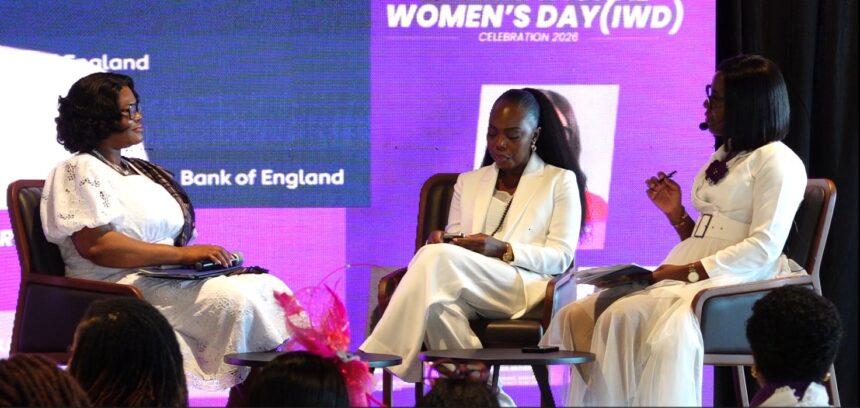
During a panel discussion featuring banking leaders from Ghana and abroad, two themes stood out: sponsorship and support.
Abena Osei-Poku, Managing Director of Ecobank Ghana, shared how a strong support system enabled her to take critical steps in her career.
Meanwhile, Jesse Jacintho, Head of the Legal Department at the Bank of Ghana, underscored the importance of mentoring as a tool for women to uplift one another within corporate spaces.
From an international perspective, Cassandra Archer of the Bank of England highlighted the need for women to seize opportunities and make their voices heard when given a seat at the table.
In her closing remarks, Matilda Asiedu echoed the panel’s consensus, noting that while peer support is vital, pairing it with active sponsorship ;where senior leaders advocate for and open doors for others ,is key to advancing more women into leadership roles.
She added that there remains significant room for improvement in getting more women into top positions, stressing that institutions must deliberately create opportunities for women to lead.
Source: Karen Dodoo-Antwi