


The Ghana Gold Board has partnered with the Ghana Armed Forces and the Forestry Commission to launch a nationwide land reclamation initiative aimed at restoring degraded forest landscapes, beginning with a 50-hectare restoration project within the Tano Nimiri Forest Reserve.
The project marks a coordinated effort between state security institutions and environmental regulators to address land degradation linked to illegal and irresponsible mining activities, while strengthening Ghana’s broader environmental sustainability agenda.
Speaking at the official signing ceremony, the Chief Executive Officer of GoldBod, Sammy Gyamfi, reaffirmed the institution’s commitment to environmental restoration as part of its Environmental, Social and Governance (ESG) obligations and Corporate Social Responsibility (CSR) strategy. He emphasized that responsible resource governance must go hand in hand with restoring ecosystems that have been impacted by mining and related human activities.

According to him, the initiative reflects a shift toward a more sustainable mining framework that prioritises long-term environmental protection alongside economic value creation. He noted that GoldBod’s intervention is not limited to regulatory oversight but extends to active participation in restoring damaged lands.
The Deputy Minister for Defence, Hon. Ernest Brogya Genfi, underscored the role of the Ghana Armed Forces in supporting national environmental protection efforts. He stressed that illegal mining and environmental degradation pose both ecological and security risks, making military collaboration essential in safeguarding forest reserves and enforcing compliance in protected areas.
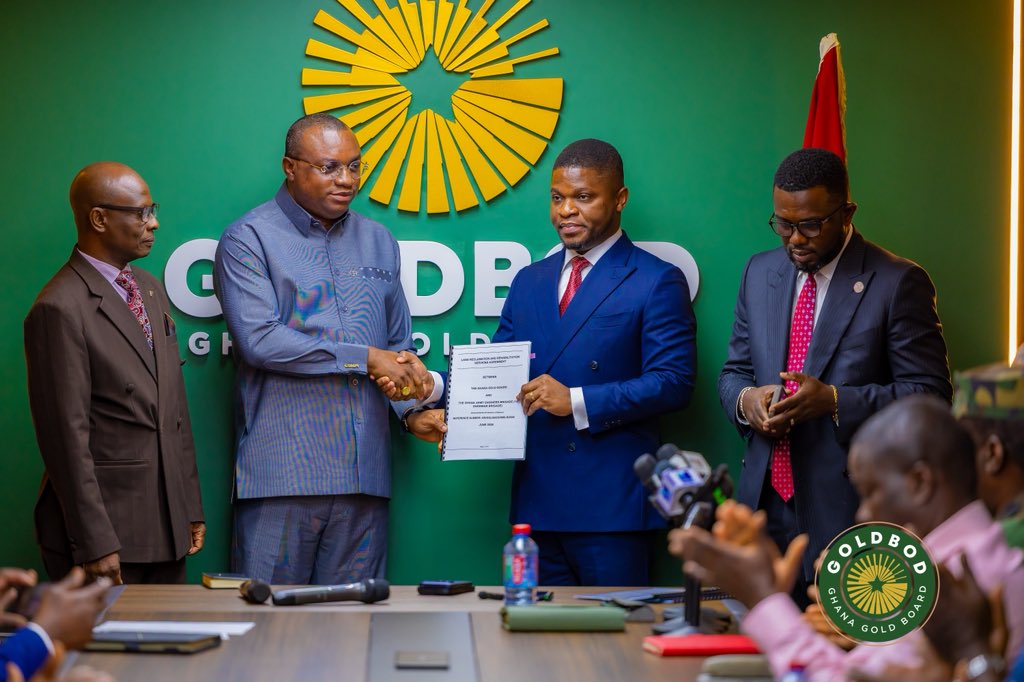
Also addressing the ceremony, the Chief Executive Officer of the Hugh Brown, representing the Forestry Commission, highlighted the urgency of restoring degraded forest ecosystems. He noted that the Tano Nimiri Forest Reserve is among several critical ecological zones requiring immediate rehabilitation to preserve biodiversity and ensure sustainable livelihoods for surrounding communities.
The 50-hectare pilot restoration project is expected to serve as a model for future reclamation exercises across other degraded forest reserves in the country. It will involve tree planting, soil rehabilitation, and long-term ecological monitoring to ensure sustained recovery of the affected areas.
Authorities involved in the project say the collaboration reflects a growing national consensus on the need to combine enforcement, institutional coordination, and environmental restoration in addressing Ghana’s land degradation challenges.
The initiative is expected to be expanded in phases, with further sites identified for restoration under the broader national reclamation framework.
SOURCE: MAVIS FANTEVI