


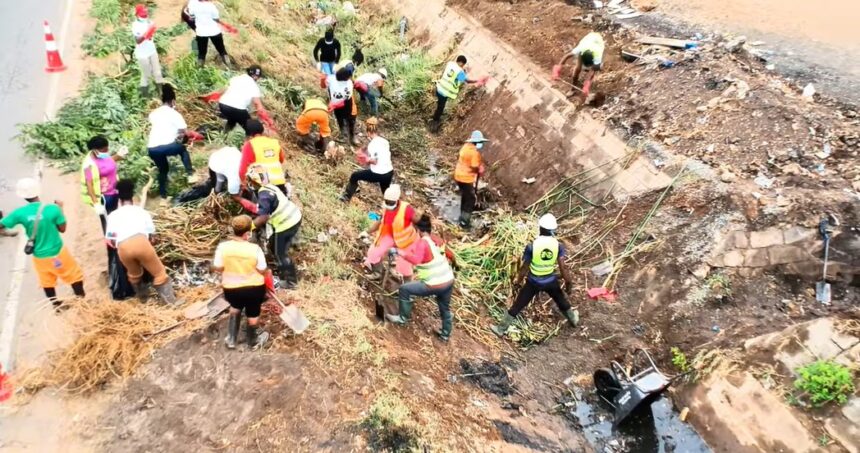
On a humid morning in Accra, a group of young volunteers armed with shovels, wheelbarrows and determination gathered around a choked drain.Within hours, heaps of plastic waste, weeds and sand are cleared, water begins to flow freely, and a familiar flood-prone area starts to look different.
For many Ghanaians, the work of the Buzstop Boys has become a familiar sight on social media, but beyond the dramatic before-and-after videos lies a deeper mission: changing mindsets and ridding the streets of waste.
“Our goal is not just cleaning.The best service I can render to God is what I render to mankind. We want young people to understand that each of us can contribute uniquely to building this country.” Says founder Kwadwo Safo.
Founded in 2023, the Buzstop Boys, initially made up of Kwadwo and his girlfriend, emerged from a simple belief that young people should move beyond blaming authorities and instead take action in their communities.What started as a small initiative has grown into a movement.
The group now works with about 350 volunteers across Accra, Cape Coast and Kumasi, including women and even retirees. More importantly, they have inspired more than 15 youth-led sanitation groups in communities such as Ashaiman and Kumasi to undertake clean-up exercises of their own.
According to the Accra Metropolitan Assembly (AMA), approximately 3,000 to 3,500 metric tonnes of solid waste are generated in the capital every day. Of this amount, it is estimated that about 30 per cent goes uncollected by formal and informal service providers.
This backlog, amounting to roughly 600 to 1,000 tonnes daily, often ends up clogging open drains, gutters and water bodies, contributing to severe flooding during the rainy season.
The human and economic costs of flooding have been significant. Over a recent 12-year period, an estimated 178,750 people were displaced by flooding in the Greater Accra Metropolitan Area (GAMA), resulting in approximately US$43.7 million in economic losses, according to the Ghana Meteoroligal Agency.
However, amid growing concerns about the situation, this youth-led movement continues to demonstrate how community action can become part of the solution. Social media has become their most powerful tool. Through TikTok, Instagram and Facebook, the group combines cleaning activities with messages about patriotism, community service and civic responsibility.
“The environment doesn’t create waste,” Kwadwo says. “It is irresponsible human behaviour that creates waste. The real challenge is changing the mindset.”
The efforts of the Buzstop Boys to ensure that many of these drains and gutters remain clear are already producing visible results. According to Kwadwo, areas such as Okponglo in the Ayawaso West Wuogon Municipality, parts of Teshie in the Krowor Municipality, and Santa Maria in the Ga Central Municipality, where the group has cleared drains and removed waste, have experienced reduced flooding compared to previous years.
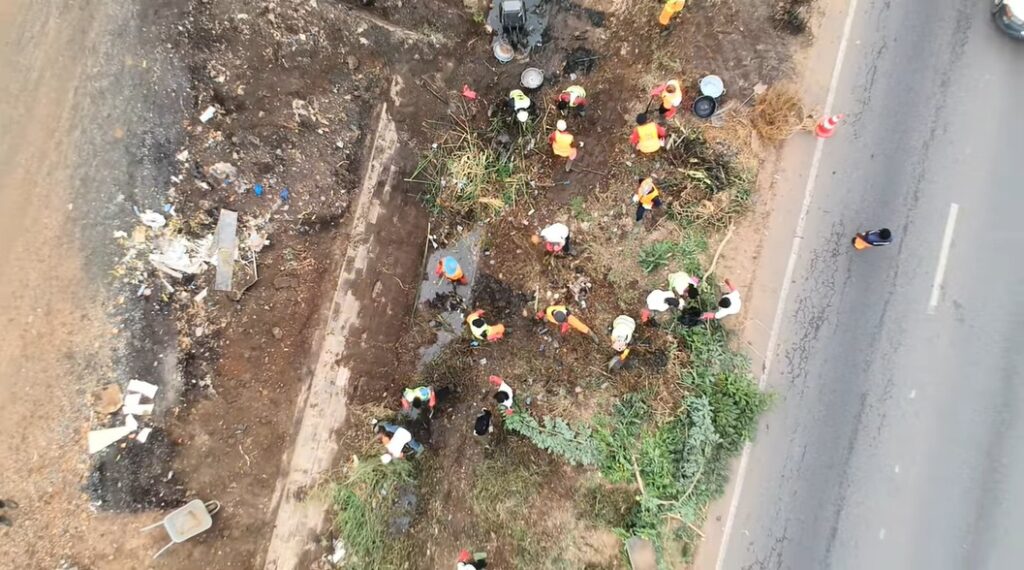
Okponglo junction gutter cleaning exercise
Source:Buzstop Boys
“We have built a brotherhood, and all these young people are now doing the little they can to sanitise their environment. We believe that if we can even get one per cent of communities to establish clean-up organisations or undertake regular clean-up exercises, we can reduce the impact of heavy rainfall and possibly prevent some flooding,” he said.
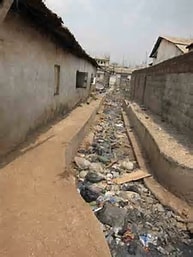
Picture of choked gutter at Darkuman junction
Despite these successes, the group believes such efforts represent only a small part of the solution to Accra’s flooding challenges.
“We are not saying we can fix everything. We are saying that if every community had motivated and supported volunteers, we could significantly reduce flooding and improve sanitation,” Kwadwo stresses.
While praising recent efforts by local authorities to strengthen sanitation enforcement, he believes existing laws are not being adequately applied.
“People continue to litter because they see no consequences,” he says. “If sanitation laws are enforced consistently, behaviour will change.”
Residents and commuters who use Okponglo junction say the difference is noticeable, particularly during heavy rains.
Joyce Danso, a resident of Madina who frequently uses the Accra-Madina Road, says:
“The area used to flood severely whenever it rained because the drain at the main Okponglo bus stop was overgrown with weeds and clogged with rubbish and sand. The flooding was especially severe around the intersection. During floods, the three lanes on the road would effectively be reduced to one, causing major traffic congestion.”
Environmental experts, however, caution that volunteer-led clean-ups alone cannot solve Ghana’s sanitation challenges. Sustained waste collection systems, stronger public education and stricter enforcement of sanitation laws remain critical.
Environmental researcher Dr. Harris Andoh says poor urban planning remains one of the major causes of flooding in parts of Accra, despite the efforts of community groups to keep drains clear.
Dr. Andoh commended the Buzstop Boys for their contribution to flood prevention through sanitation and clean-up exercises but noted that the group faces challenges, including inadequate equipment and resources.
“The Buzstop Boys are doing great work. They are pushing hard, but we should remember the scale at which they are operating. The lack of proper equipment and other resources makes their work difficult,” he said.
As Ghana continues to grapple with flooding and waste management challenges, the Buzstop Boys offer something often missing from the conversation: proof that small, community-led actions can create visible change. Their story is not only about cleaner drains but also about the possibility of building a culture where responsibility begins with ordinary citizens.
BY: KAREN ANTWI