


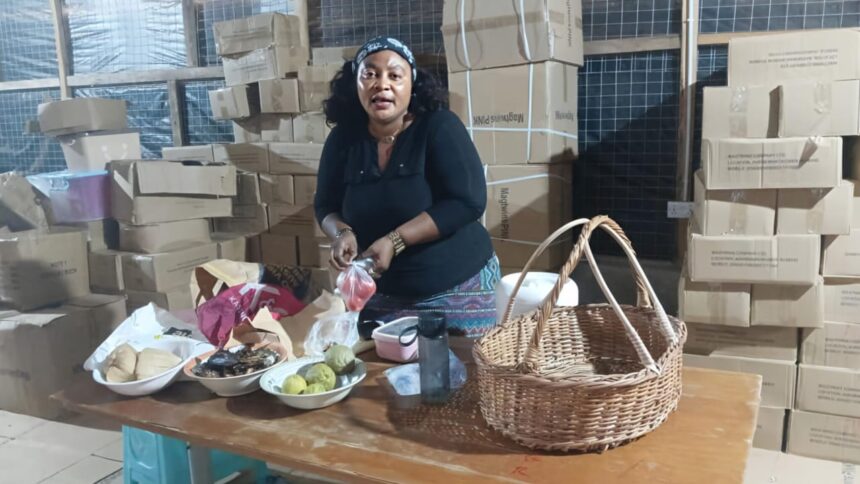
The Chief Executive Officer of the MAGTWINS Eagle Foundation, Mrs Patricia Kwarteng, has renewed calls for Ghanaians to reduce their dependence on polythene bags and single-use plastics, describing them as major contributors to the country’s recurring flooding and environmental degradation.
Mrs Kwarteng, who has led sanitation education campaigns reaching more than 1,000 people, urged citizens to embrace traditional and environmentally friendly alternatives such as baskets and paper bags, which were commonly used before the widespread adoption of plastics.
Speaking to Atinka News’ Obofo Michael during a community outreach programme, she encouraged women to take the lead by carrying reusable baskets or paper bags to the market.
“As a woman, when going to the market, you should carry a basket or paper bag. That alone can prevent the unnecessary use of polythene bags for every item purchased,” she said.
According to her, the growing culture of wrapping virtually every purchase in plastic has become a major environmental challenge. She noted that after heavy rains, gutters and drainage systems are often clogged with discarded plastic bags and sachet water wrappers, leading to severe flooding.
“It is time for Ghanaians to return to the practices of the past when our markets operated without plastic bags. Back then, our gutters were cleaner and our communities were healthier,” she stated.
Mrs Kwarteng also appealed to sachet water vendors and consumers to adopt more sustainable practices. She suggested that customers carry reusable water bottles, allowing vendors to pour the water into them while retaining the empty sachets for proper disposal.
“Anyone buying sachet water should use a reusable bottle. Let the seller pour the water into it and properly dispose of the empty sachet. Sanitation must become everyone’s priority,” she advised.
Expressing concern over the country’s persistent flooding, she stressed that plastic waste remains one of the biggest contributors to blocked drainage systems.
“Flooding is happening everywhere, and when the waters recede, what do we find? Gutters choked with plastic waste. We are creating these problems ourselves,” she remarked.
Mrs Kwarteng emphasised that maintaining a clean environment is a shared responsibility and urged citizens to dispose of plastic waste responsibly.
“When you finish eating or drinking from any plastic container, don’t throw it into gutters or onto the streets. Keep it until you find a proper waste bin,” she said.
She further called on Metropolitan, Municipal and District Assemblies (MMDAs) to intensify public education campaigns, particularly among market traders, noting that indiscriminate disposal of refuse in markets significantly contributes to flooding during the rainy season.
“It is time for assemblies to educate market women and traders on proper waste management because abandoned refuse in markets eventually ends up blocking our drains,” she added.
Mrs Kwarteng also advocated stricter enforcement of sanitation bylaws alongside sustained public education.
She appealed to schools, churches, mosques and traditional authorities to join efforts to reduce plastic waste and promote environmentally friendly alternatives.
She disclosed that the MAGTWINS Eagle Foundation will continue to roll out community sensitisation programmes across the country to encourage the use of baskets, paper bags, and reusable containers.
“Everyone has a role to play in keeping Ghana clean. If we change our attitude towards plastic waste today, we will save our communities from floods tomorrow,” she concluded.