

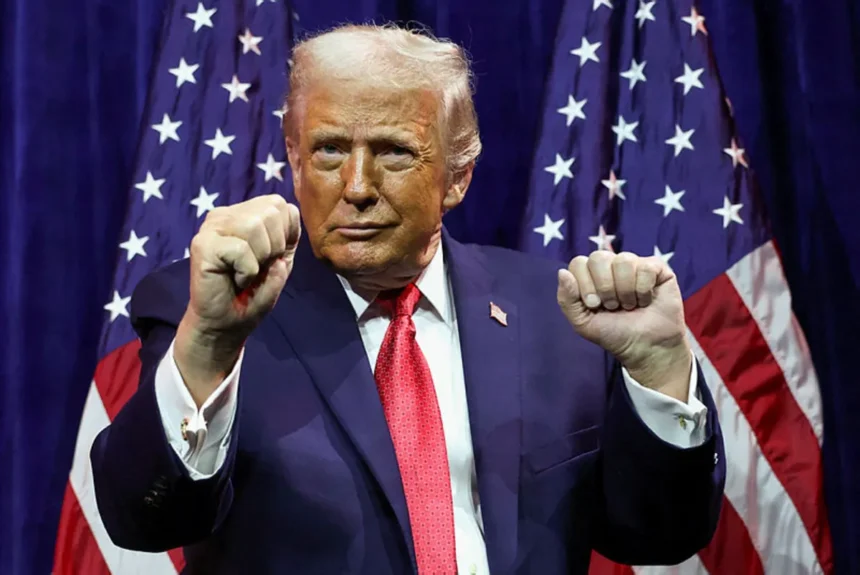
According to US President Donald Trump, the US may continue to be involved in Venezuela for years. After US forces captured Venezuelan leader Nicolás Maduro in a raid on Saturday, he told the New York Times that “only time will tell” how long his government would “oversee” the country’s governance.
In discussing Venezuela’s future, President Donald Trump avoided committing to a date for elections to replace interim president Delcy Rodríguez, leaving uncertainty over when or if a democratic vote will be held.
Opposition leader María Corina Machado, however, said Maduro’s removal has started an “irreversible process” toward a free Venezuela and has pledged to return to her homeland.
Days after Trump declared that his administration will govern the oil-rich country, reporters for the New York Times (NYT) questioned him about his plans for Venezuela’s future.
The White House had declared earlier on Wednesday that the United States would “indefinitely” regulate sales of oil that was sanctioned.
Chris Wright, the US Energy Secretary, contended that in order to exert pressure on the Caracas interim administration, the US needed control over Venezuela’s oil sales.
Although he conceded that it would “take a while” to establish the nation’s oil sector, Trump stated that his administration would be “taking oil” from Venezuela, which has the greatest proven reserves in the world.
Due to years of US sanctions and poor management by both the Maduro administration and that of his predecessor, Venezuela’s oil production has drastically decreased.
Speaking to The New York Times, President Trump said Secretary of State Marco Rubio has maintained constant engagement with Delcy Rodríguez, the interim leader appointed by Venezuela’s Supreme Court, which remains aligned with Maduro loyalists.
According to Trump, Rodríguez has been cooperative, adding that the interim government had agreed to use oil revenues solely to buy US products.
The NYT writers claim that Trump did not respond to their inquiries about why he acknowledged Rodriguez as the new leader of Venezuela.
Following Maduro’s ouster, many Venezuela watchers believed opposition leaders Edmundo González and María Corina Machado would promptly return home to help shape the country’s transition.
However, Trump disparaged Machado in his first press conference after the US raid, claiming that she lacked the “respect” and backing necessary to govern Venezuela.
“I think it would be very tough for her to be the leader,” he mentioned.
Before the 2024 presidential election, Machado was able to rally opposition groups behind her, but Maduro-aligned officials prevented her from running. Then, using former diplomat González as a stand-in, she threw her support behind him.
Maduro was proclaimed re-elected by the electoral council, which is likewise controlled by supporters of the regime. However, the opposition’s independently certified voting totals indicate González won by a wide margin.
Machado went into hiding within Venezuela, while González fled into exile to avoid the government repression that followed the election.
In order to receive the Nobel Peace Prize for her “tireless work promoting democratic rights” in Venezuela, she traveled dangerously by land, sea, and air to Oslo in December.
Although her current location is unknown, she has stated that she intends to return to Venezuela shortly.
She maintained that Maduro’s overthrow has put her nation on an unstoppable path to freedom in an interview with the opposition news website La Patilla.
“As short and swift as possible” is what she hoped this next stage of the transition process would be.
The temporary administration, which she described as “the same regime it was under Maduro,” was “being given instructions to dismantle itself,” she continued.
Machado advocated that González’s mandate be honored and maintained that he was the rightful president-elect.
She emphasized that the release of the political prisoners was “the first thing” that had to happen.
Machado is not alone in calling for the release of the more than 800 political prisoners detained in Venezuela’s infamous prisons.
Republican senator María Elvira Salazar demanded their release “immediately” in a number of social media messages on Wednesday.
But according to the journalists who met with him, Trump “appeared far more focused on the rescue mission than the details of how to navigate Venezuela’s future” during his interview with the New York Times.
He responded that “we will rebuild it in a very profitable way” when asked about US ambitions for Venezuela.
“We’re going to be using oil, and we’re going to be taking oil. We’re getting oil prices down, and we’re going to be giving money to Venezuela, which they desperately need.” He continued.
On Friday, the US president is scheduled to meet with officials of three of the biggest US oil firms at the White House to further discuss those plans.
Source: BBC