

On March 25, 2026, the United Nations General Assembly passed a resolution declaring the transatlantic slave trade a crime against humanity and affirming the case for reparations. It passed with 123 votes in favor. Three countries voted against it. The United States, Israel, and Argentina said no. Fifty-two countries, most of them European, including the United Kingdom, Portugal, and Spain, chose to abstain rather than vote either way.
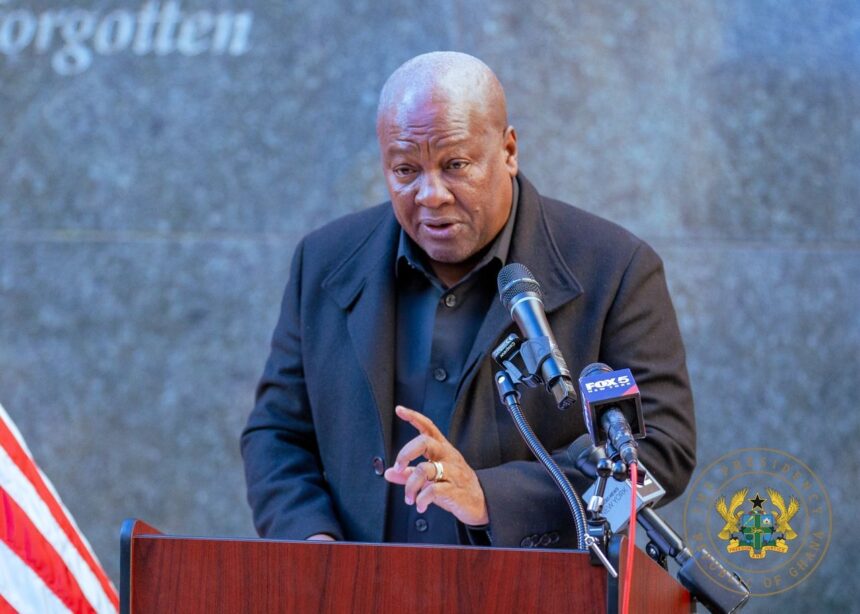
The country that brought this resolution to the floor was Ghana. And the person who stood at the podium to present it was President John Dramani Mahama.
What the Resolution Actually Says
The resolution does several things. It formally affirms that the transatlantic slave trade was the gravest crime in human history, not just a dark chapter or a historical tragedy, but a crime that demands a response. It calls on member states to acknowledge this history, to consider formal apologies, and to engage seriously with the question of reparations. It also calls for the return of African artefacts still held in foreign museums.
The resolution does not mandate specific payments; what it does is open a formal global conversation at the highest diplomatic level, one that Africa and the Caribbean have been trying to force for decades. This is the first time that conversation has reached the UN General Assembly in this form and passed.
Prez Mahama’s Role
The African Union appointed Prez Mahama as its Champion for Reparations, a title he has described as a solemn obligation rather than an honor. In that role, he has spoken at summits and worked to build a unified position among African nations on what reparations should actually look like.
The day before he presented the resolution at the UN, Mahama visited the African Burial Ground in Manhattan and laid a wreath to honor enslaved Africans.
When he addressed the General Assembly on behalf of the 54-member African Group, the largest regional bloc at the UN, he described the resolution as resting on three pillars. Historical accuracy. Legal defensibility. And alignment with both the African continent and the diaspora.
The Opposition
The United States representative made clear that Washington does not recognize a legal right to reparations for historical wrongs that were not illegal under international law at the time they occurred. The US also objected to what it called narrow agendas being pushed through a body meant to maintain international peace and security.
Countries like the UK, Portugal, and Spain, which abstained, were directly involved in the slave trade on a large scale. Centuries of their economic development were built on it. Abstaining rather than voting yes was a way of neither endorsing the resolution nor openly opposing it, sitting on the fence at a moment that was asking them to stand somewhere.
Critics of the resolution have argued that current governments should not be held responsible for the actions of their predecessors. This is the most common objection. It is also the one that reparations advocates have spent years trying to answer, pointing out that the wealth generated by slavery was not left behind in the past. It moved forward, accumulated, and shaped the economic conditions of the present.
Why Ghana
Ghana’s particular role in this conversation has a complicated history behind it. The country’s coastline was a central point of departure during the slave trade. Forts like Cape Coast Castle and Elmina held facilities where captured Africans were kept in dungeons before being loaded onto ships. These buildings still stand. Tourists walk through them. Diaspora Africans return to them to reckon with what happened.
Ghana has actively welcomed the African diaspora through initiatives like the Year of Return in 2019, which invited people of African descent to come home to Ghana. Reparations, in this context, are not a foreign diplomatic abstraction but rather connect to something Ghana has been living with physically and emotionally for a long time.
What Comes Next
The practical questions remain: Who pays? How much? To whom? Through what mechanism? These are not simple questions, and there is no consensus on the answers yet. But the resolution creates space for those questions to be asked seriously at a formal level, something that has not existed before in quite this way.
Credit: Manasseh Wintemah Apurum