
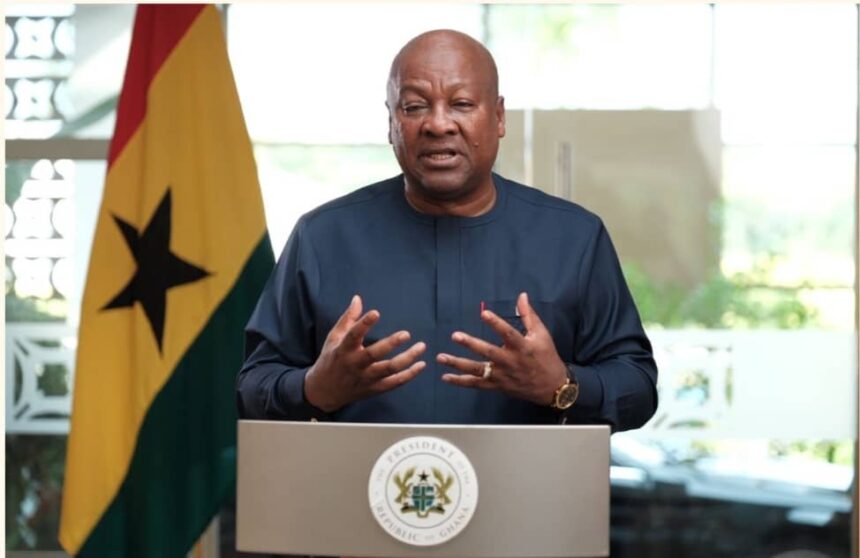
One year after inheriting what he described as a nation in “deep economic and social distress,” President John Dramani Mahama says Ghana is firmly on the road to recovery. Reflecting on the state of the country when his administration assumed office, he recalled an economy “on its knees,” weighed down by youth unemployment, crumbling infrastructure, eroded public trust and a growing sense of despair.
“We were told that recovery would take a generation,” he said. “But I knew something our critics did not. I knew the resilient spirit of the Ghanaian people.”
Over the past 12 months, President Mahama said, his government has pursued prudent economic management and difficult but necessary reforms aimed at stabilizing the economy and restoring confidence. Inflation, which hovered above 23 percent at the end of 2024, has been sharply reduced. The government hopes to close 2025 with inflation in single digits, slightly above five percent.
He also pointed to relative currency stability, noting that Ghana is on track to be ranked among the world’s best-performing currencies in 2025, an achievement he attributed to disciplined fiscal and monetary coordination.
Beyond macroeconomic indicators, Mr. Mahama said his administration is accelerating growth and expanding opportunities for young people through targeted interventions across key sectors. Business confidence, he added, has returned, spurring a surge in both domestic and foreign direct investment. “Our policies are working because investors believe once again in the Ghanaian economy,” he said.
On the international front, the President announced that Ghana has regained credibility with its global partners, completing a renegotiation of its debt obligations. He emphasized that the deal was struck on terms that safeguard Ghana’s sovereignty while ensuring long-term debt sustainability.
President Mahama also disclosed that Ghana has begun the process of exiting the International Monetary Fund program “with dignity,” stressing that the country is engaging international partners not as supplicants but as equals.