


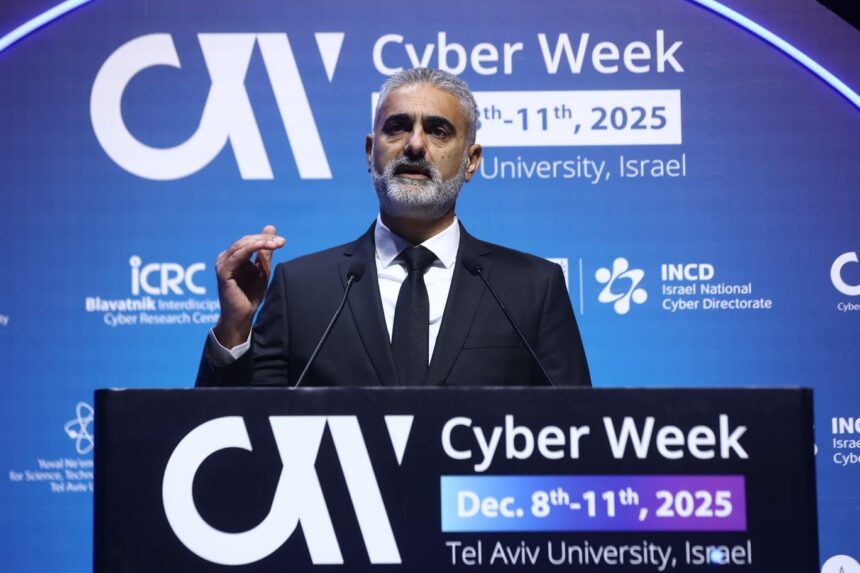
The head of Israel’s National Cyber Directorate has warned that future conflicts could be waged entirely in cyberspace, with nations targeting digital infrastructure rather than deploying conventional weapons.
Speaking at the Cyber Week conference at Tel Aviv University, Brigadier General (res.) Yossi Karadi said the world is moving toward a new form of warfare in which power grids, communications networks, transport systems and water supplies could become primary targets.
In his first public address since assuming office, Mr Karadi said Israel is already experiencing the early stages of what he described as a “cyber-based war,” citing sustained cyber and influence operations attributed to Iran over the past six months.
During Israel’s recent military campaign, Operation Rising Lion, cyber authorities detected a series of cyberattacks and disinformation campaigns. Among them was an attempted ransomware attack on Shamir Medical Center on Yom Kippur, which was successfully blocked.
According to Mr Karadi, the attack was carried out by an Iranian state-backed actor posing as a criminal ransomware group known as Qilin, underscoring what he described as the increasingly blurred lines between organised cybercrime and hostile state activity.
“We are heading toward an era where a war could begin and end entirely in the digital domain,” he said. “Power stations shut down, communications severed, transportation paralysed and water supplies disrupted — this is not science fiction, but a very real trajectory.”
He cautioned that in such conflicts, every digital system could become a frontline and ordinary civilians would be directly affected.
Data presented by the National Cyber Directorate showed that during a two-week period of the operation, Israeli authorities identified 1,200 influence campaigns targeting civilians. Officials said millions of people were exposed to deceptive messages and manipulated videos.
Other trends observed included coordinated cyber and physical attacks, large-scale disinformation during emergency situations, and a shift by Iranian-linked groups from intelligence-gathering to disruptive and destructive cyber operations.
Mr Karadi also referenced a missile strike on the Weizmann Institute of Science, which he said was accompanied by cyber and psychological tactics, including the hacking of security cameras and the sending of threatening emails to academic staff.
Citing Microsoft data, he noted that Israel ranked as the third most targeted country globally for cyberattacks over the past year, accounting for 3.5 per cent of incidents worldwide.
“Our dependence on digital systems, combined with the rapid spread of artificial intelligence, creates enormous opportunities,” Mr Karadi said. “But it also gives cyber adversaries an almost unlimited arena.”
By Karen Dodoo Antwi