


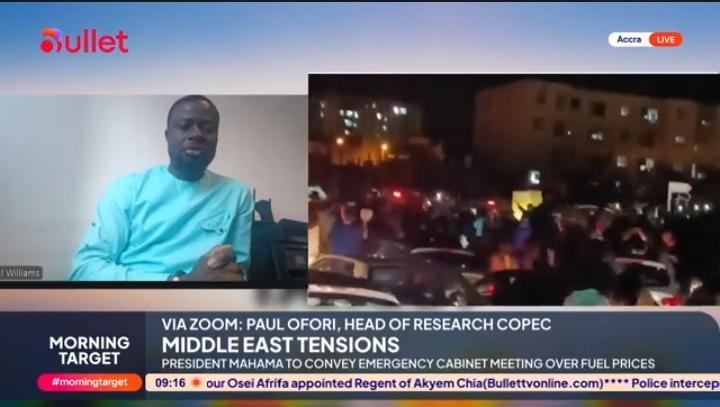
The Head of Research at the Chamber of Petroleum Consumers (COPEC), Paul Ofori, says Ghana could see a gradual easing in fuel prices following the recent ceasefire between the United States and Iran, although consumers should still expect short-term increases.
The ceasefire, which temporarily halted hostilities and reopened key global oil supply routes such as the Strait of Hormuz, has already triggered a sharp drop in crude oil prices, falling by about 13 to 15 percent on global markets.
Speaking Bullet TV’s Morning Target on April 8, Mr. Ofori described the development as a major relief for oil-importing countries like Ghana, noting that it has reduced fears of a prolonged global energy crisis.
According to him, if the conflict had continued, Ghana could have seen petrol prices rise to between 16 and 20 cedis per litre, while diesel prices might have surged to between 20 and 25 cedis per litre within weeks.
He explained, however, that despite the global price drop, the impact of the ceasefire will not be felt immediately at the pumps.
This, he said, is because Bulk Distribution Companies (BDCs) had already imported petroleum products at higher prices during the peak of the conflict, and those costs will still reflect in the next pricing window.
“We’re not going to see the effects immediately,” Mr. Ofori stated, cautioning consumers against expecting instant reductions simply because global crude prices have begun to fall.
Analysts say although the ceasefire has eased tensions and removed some of the “risk premium” from oil prices, uncertainty remains over how quickly global supply chains will fully stabilise.
Mr. Ofori, however, expressed optimism that if the ceasefire holds and global prices continue to decline, Ghana could begin to experience some relief at the pumps by mid-May.
He added that sustained peace between the United States and Iran would be key to stabilising the global oil market and ultimately reducing the burden of fuel costs on Ghanaian consumers and businesses.
CREDIT: Mavis Fantevi