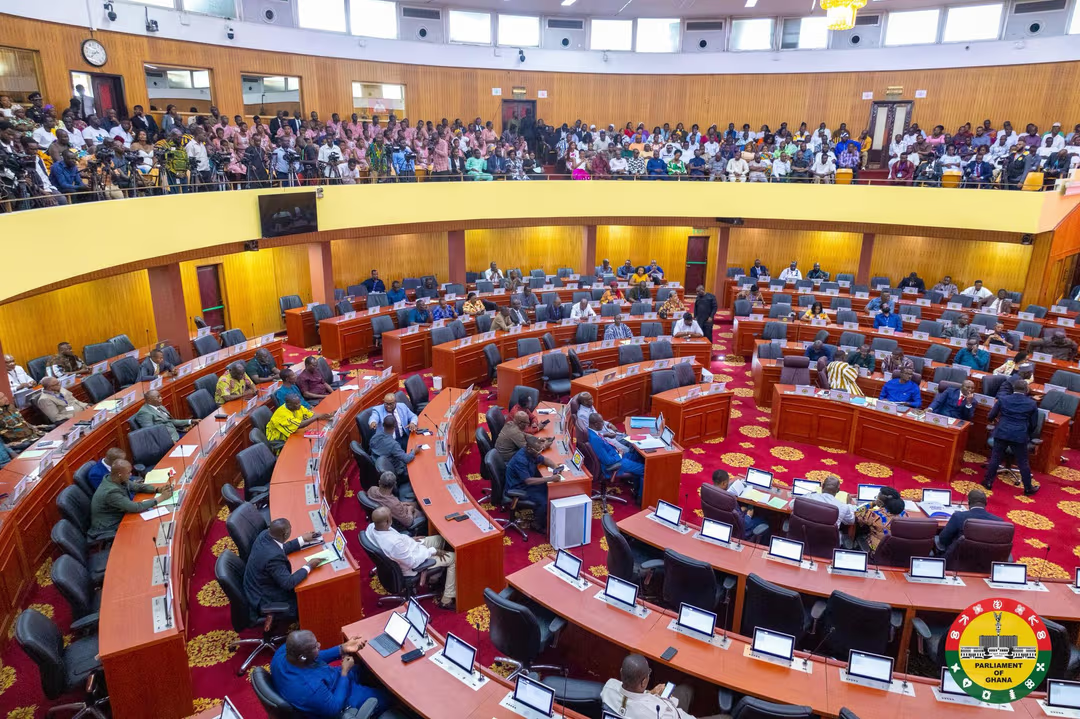



The spotlight is once again on the Kpandai Constituency following a court decision that has reset the parliamentary race on December 30th this year.
Although a winner was initially declared in the 2024 parliamentary election, the results were later challenged in court over alleged electoral irregularities, including issues surrounding the conduct of the poll and the validity of parts of the process.
After hearing the case, the Tamale High Court on November 24th this year nullified the parliamentary election results, effectively setting aside the declaration and directing the Electoral Commission to conduct a fresh election. As a result, the Kpandai seat was declared vacant, triggering a by-election.
This development has revived political contestation in a constituency that history shows is deeply competitive, with victories often decided by narrow margins.
So, as parties prepare once again to test their strength in Kpandai, a look at the historical election trends offers important insight into what may lie ahead.
Kpandai has steadily evolved from a one-party stronghold into one of Ghana’s most competitive parliamentary constituencies.
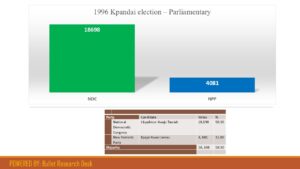
From 1996 through to 2012, the National Democratic Congress, the NDC, dominated the seat, recording commanding victories. In 1996, the party won with over 84 percent of the vote, a margin that reflected near-total control of the constituency at the time.
That dominance, however, began to decline gradually. By 2004, the NDC’s vote share had dropped to about 60 percent, and in 2008, the party won with just 38.27 percent, narrowly ahead of the NPP, which secured 36.24 percent. That election marked the first clear sign that Kpandai was becoming competitive.
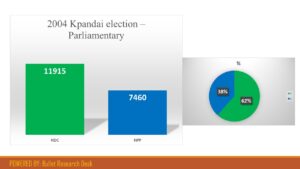
The real turning point came in 2016, when the New Patriotic Party, NPP, flipped the seat. The NPP’s Matthew Nyindam won with 50.14 percent, edging out the NDC candidate who polled 48.18 percent, a margin of less than two percentage points.
Since then, elections in Kpandai have been decided by very small margins, confirming its status as a swing constituency.
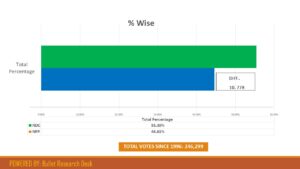
In the 2024 parliamentary election, the NPP was initially declared winner with 53.47 percent of the vote against the NDC’s 46.33 percent. However, that result was later void by the court, throwing the seat back into contention.
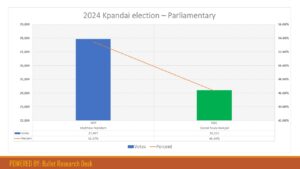
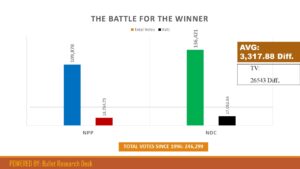
According to trend analysis compiled by the Bullet Research Desk, the historical average margin between the two main parties in Kpandai stands at roughly 3,300 votes, underscoring just how finely balanced the constituency has become.
The data suggests one clear conclusion: Kpandai is no longer safe for any party, and future elections, including a possible by-election, will likely be decided by turnout, candidate appeal, and ground campaign strength rather than party tradition.
By: Mensah Maxwell, Data Analyst, Bullet Research Desk