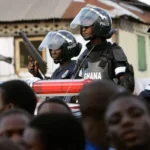


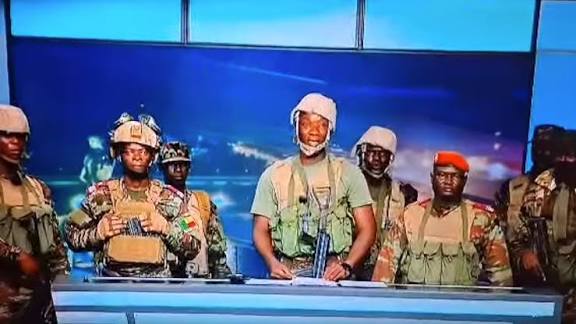
Security forces in Benin are hunting soldiers involved in Sunday’s failed coup attempt, after mutineers briefly seized the national broadcaster and claimed to have taken hostages. President Patrice Talon later assured citizens that the situation was “totally under control.”
Gunfire was reported near the presidential residence in Cotonou, and explosions shook the capital in the afternoon, believed to be the result of air strikes. Flight-tracking data showed three Nigerian aircraft entering Benin’s airspace before returning home. Nigeria confirmed its fighter jets helped “dislodge the coup plotters from the National TV and a military camp” at Talon’s request, describing the mutiny as a “direct assault on democracy.”
Arrests and Leadership of the Mutiny
Government spokesperson Wilfried Leandre Houngbedji told Reuters that 14 people had been arrested. Local journalists reported that 12 of them stormed the TV station, including a dismissed soldier. The coup leaders identified themselves as being under Lt Col Pascal Tigri, whose whereabouts remain unknown.
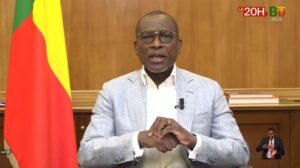
In a national address, Talon praised loyalist forces for “clearing the last pockets of resistance” and vowed that “this treachery will not go unpunished.” He expressed condolences to victims and those still held by fleeing mutineers, though casualty figures remain unclear.
Rebels’ Grievances
The rebel soldiers accused Talon of mismanaging the country, citing the deteriorating security situation in northern Benin, where jihadist groups linked to al-Qaeda and Islamic State have expanded southwards. They condemned neglect of fallen soldiers’ families, cuts to healthcare, including the cancellation of state-funded dialysis and rising taxes. They also criticized restrictions on political activity.
Regional and International Reaction
The French and Russian embassies urged their citizens to remain indoors, while the US embassy advised avoiding Cotonou, especially near the presidential compound. Ecowas and the African Union swiftly condemned the coup attempt. Pro-Russian social media accounts have hailed the mutiny, a situation reflecting wider geopolitical tensions in West Africa, where Russia has deepened ties with Sahel states that recently quit Ecowas to form the Alliance of Sahel States.
Political Context
Benin, long seen as one of West Africa’s more stable democracies, has faced growing criticism under Talon’s leadership. The 67-year-old businessman nicknamed the “king of cotton” came to power in 2016 and is due to step down next year after completing his second term. He has endorsed Finance Minister Romuald Wadagni as his successor ahead of April’s elections.
Supporters credit Talon with economic development, but opponents accuse him of suppressing dissent. In October, the electoral commission barred the main opposition candidate from running, citing insufficient sponsors. Last month, parliament passed constitutional amendments creating a Senate and extending terms for elected officials from five to seven years, though the presidential two-term limit remains intact.
The attempted coup in Benin comes just over a week after Guinea-Bissau’s President Umaro Sissoco Embaló was overthrown, and follows recent coups in Burkina Faso, Guinea, Mali, and Niger. Analysts warn that the wave of mutinies threatens regional stability, with Benin now added to the list of countries grappling with democratic backsliding and insurgent violence.
Source: BBC