

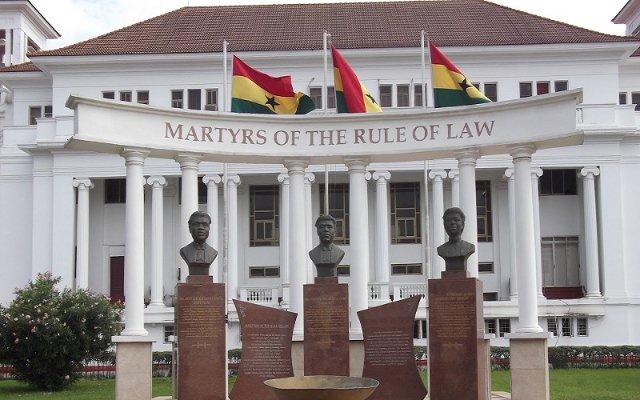
The Supreme Court has admitted 14 civil society organisations (CSOs) into the ongoing constitutional case challenging the legality of the Office of the Special Prosecutor (OSP).
A seven-member panel of the apex court, presided over by Chief Justice Paul Baffoe-Bonnie, granted the application after lawyers for the CSOs argued that the organisations possess expertise in governance, accountability and anti-corruption matters that could assist the court in determining the case.
Counsel for the applicants, Kizito Beyuo, told the court that the organisations have longstanding institutional experience in anti-corruption advocacy and public governance issues, making their participation necessary in a matter with significant national implications.
The admitted organisations include CDD-Ghana, Transparency International Ghana, IMANI Africa, Democracy Hub, STAR-Ghana Foundation, Penplusbytes, Africa Education Watch and several other groups.
The substantive suit, filed by private citizen Adamtey, questions whether aspects of the establishment and operational structure of the OSP are consistent with Ghana’s 1992 Constitution.
The Office of the Special Prosecutor was established under the Office of the Special Prosecutor Act, 2017 (Act 959) to investigate and prosecute corruption-related offences, particularly cases involving public officials and politically exposed persons.
Since its establishment, the OSP has handled a number of high-profile corruption investigations and prosecutions, becoming one of Ghana’s most prominent anti-corruption institutions.
The Supreme Court’s decision to admit the CSOs is expected to broaden the public interest and legal dimensions of the case, given the active role many of the organisations have played in advocating stronger anti-corruption reforms and institutional accountability.
The case continues to attract national attention due to the potential implications any ruling could have on the future mandate and operations of the Office of the Special Prosecutor.
CREDIT: Mavis Fantevi