
Source: Philip Azu
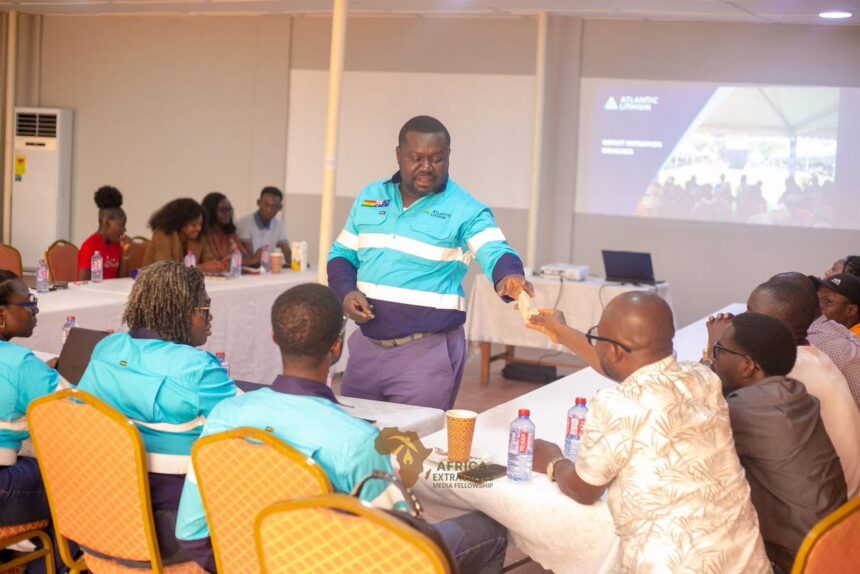
The maiden cohort of the Africa Extractives Media Fellowship has successfully completed its training programme with a practical field visit to the Ewoyaa Lithium Project in Ghana’s Central Region, providing fellows with a rare firsthand experience of the realities of lithium exploration and extraction.
After weeks of intensive classroom sessions on extractive sector reporting, mining governance, environmental sustainability, and resource accountability, the fellows finally stepped beyond theory and into the heart of mining operations, where they witnessed drilling activities, interacted with technical experts, and gained deeper insight into the fast-growing lithium industry.
The tour follows a similar field visit to the Tema Oil Refinery some weeks ago. For many of the journalists, the visit was more than just an educational tour.
It was an eye-opening experience that brought to life many of the issues discussed during the fellowship. Walking through the project site, observing ongoing exploration activities, and engaging with officials on critical questions surrounding mining operations provided the fellows with a practical understanding of the opportunities and challenges within the extractive sector.
The visit also highlighted the growing importance of lithium in the global clean energy transition, as countries around the world increasingly depend on critical minerals for the production of electric vehicle batteries and renewable energy technologies.
Speaking after the engagement, several fellows described the experience as transformational, noting that it had significantly improved their understanding of extractive sector reporting and strengthened their ability to tell more balanced, factual, and impactful stories.
According to some participants, covering mining and extractive issues from the newsroom alone often limits a journalist’s appreciation of the technical, environmental, and social dynamics surrounding the industry.
However, being physically present at the project site offered them a clear perspective on how mining operations function, the concerns of host communities, environmental considerations, and the level of accountability expected from both regulators and mining companies.
The fellows also had the opportunity to ask direct questions on issues relating to environmental protection, local participation, land use, and the long-term benefits of lithium mining to surrounding communities and the country at large.
Organisers of the fellowship explained that the programme was designed to build a new generation of African journalists with specialised knowledge in extractive sector reporting, particularly at a time when Africa’s mineral resources are attracting increasing global attention.
They noted that while Africa remains central to the future of the global green economy, the continent also needs well-trained journalists capable of reporting accurately and critically on how its natural resources are managed.
The Ewoyaa Lithium Project, regarded as one of Ghana’s emerging lithium prospects, continues to generate national and international interest due to the increasing global demand for critical minerals.
For the fellows, the experience marked not just the end of a 6-month training programme, but the beginning of a deeper responsibility, to tell Africa’s extractive story with greater depth, accuracy, and accountability.
As the curtain falls on the inaugural Ghana cohort of the Africa Extractives Media Fellowship which took place in October 2025, participants are expected to return to their various media platforms better equipped to produce compelling stories that inform the public and contribute to transparency and sustainable resource governance across the continent.