


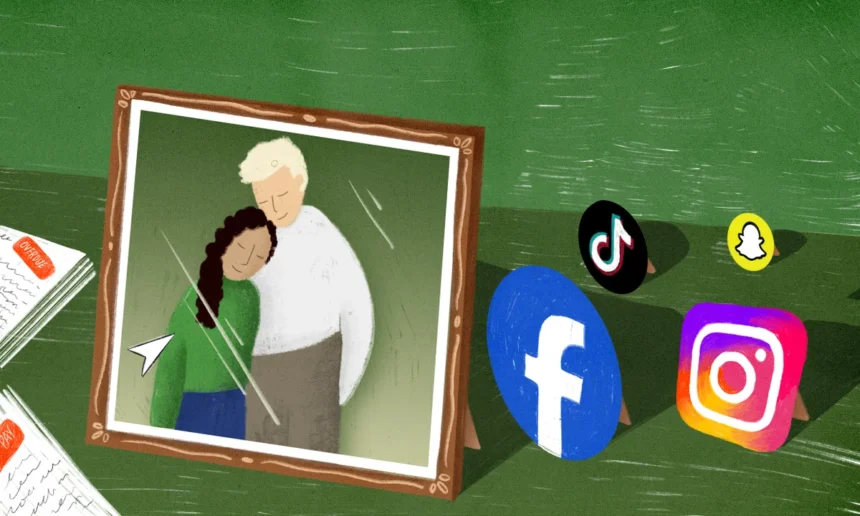
Somewhere right now, a Facebook profile is celebrating a birthday that its owner is not alive to see. Friends are posting on the wall. Old photos are surfacing in memory features. And somewhere, a grieving family member is scrolling through it all, caught between comfort and a feeling they cannot quite name.
This is the quiet reality of death in today’s digital age. We leave behind far more than photographs and memories now. We leave behind accounts, posts, voice messages, emails, and years of recorded behaviour. And that data is increasingly being used to keep versions of us alive long after we are gone.
Facebook alone is estimated to have tens of millions of profiles belonging to people who have died. The platform allows these pages to be memorialised, turning them into spaces for remembrance. That is, in many ways, a beautiful thing. Grief is long, and having a place to mark it can help. But it also means the dead remain present in our feeds in ways that can feel disorienting, even unsettling sometimes. An algorithm does not know that someone has passed. All it does is simply to show that their birthday is coming up.
Elsewhere in the world, companies have already built tools that can recreate a person’s voice from audio recordings. Others have trained AI models on someone’s text messages, journal entries, and social media posts to generate responses that sound like that person. There are services built specifically around grief, offering people the chance to talk to a digital version of someone they have lost.
The people who use these tools often describe the experience as deeply comforting, and is often seen as a chance to say the things that were left unsaid, which is entirely understandable. Grief makes people reach for anything that eases the pain, and there is nothing shameful in that.
But one ethical question that comes up is, did the person who died consent to being recreated this way? A digital version of someone is built from the things they shared in life, but they shared those things without knowing they would become training data for an AI. There is something uncomfortable about that, even if the intention behind the tool is kind. The dead cannot give consent. They cannot update the version of themselves that gets reconstructed. They are frozen in what they left behind.
There is also the question of what this does to the people left behind. Grief, as painful as it is, serves a purpose, as it is how we slowly come to accept that someone is gone. If technology makes it possible to hold a conversation with a digital version of a loved one years after their death, does that help the process of grieving, or does it delay it? Therapists and researchers are only beginning to explore this.
What is clear is that death, for the first time in human history, is no longer the end of a person’s presence in the world. The digital footprint remains. The question now is who gets to decide what happens to it, and whether the living have the right to reshape it in the image of their grief.
Credit: Manasseh Wintemah Apurum