


Amnesty International has welcomed the U.N. General Assembly’s adoption of a resolution recognizing the chattel enslavement of Africans as a crime against humanity, calling it a landmark victory for legal recognition and reparative justice.
The resolution, tabled by Ghana on behalf of the African continent and people of African descent, passed with 123 member states in favor, three against and 53 abstentions.
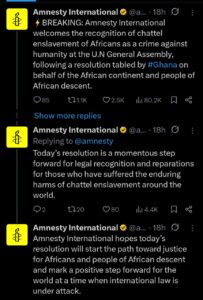
“Amnesty International welcomes the recognition of chattel enslavement of Africans as a crime against humanity at the U.N. General Assembly, following a resolution tabled by Ghana on behalf of the African continent and people of African descent,” the organization said in a statement.
The group emphasized that the legacy of slavery and colonialism continues to harm communities worldwide more than a century after the transatlantic slave trade was formally abolished.
“Across the world, people are still suffering the long-lasting effects of slavery and colonialism, manifesting in today’s racism and global inequality, while states and private actors profited from these historical injustices,” Amnesty noted.
The organization hailed the measure as a pivotal development in the decades-long struggle for reparatory justice, saying it lays a foundation for accountability and redress.
“Today’s resolution is a momentous step forward for legal recognition and reparations for those who have suffered the enduring harms of chattel enslavement around the world,” Amnesty said.
The resolution, spearheaded by Ghana’s Foreign Minister Samuel Okudzeto Ablakwa, formally declares slavery and the transatlantic slave trade as among the greatest injustices against humanity. It calls on former slave-trading nations to engage in dialogue with African states and the African Union to address historical wrongs through measures such as financial compensation, debt cancellation, development assistance and the return of looted cultural artifacts.
Amnesty’s endorsement adds weight to the resolution, reflecting a growing consensus among human rights organizations that reparatory justice is essential to addressing racial inequality. The statement also underscored the role of both states and private entities that profited from slavery, signaling that accountability may extend beyond governments to corporations and institutions.
While the resolution is nonbinding, its adoption with a strong majority and support from major human rights groups is expected to intensify pressure on former colonial and slave-trading powers to engage substantively with reparations demands.