


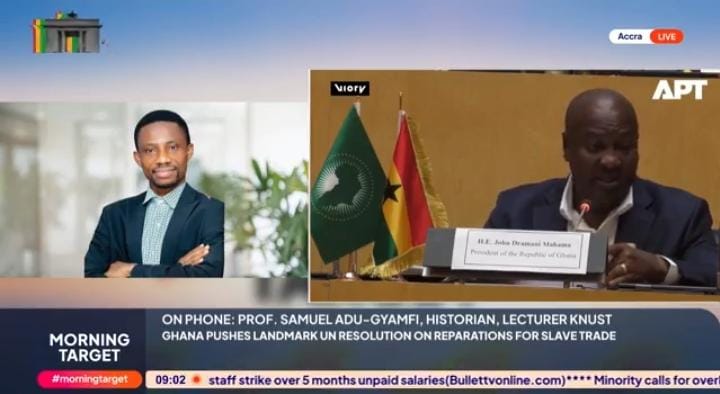
Calls for reparations for the transatlantic slave trade are gathering renewed international momentum, as President John Dramani Mahama leads Ghana’s campaign at the United Nations. Amid these developments, Political historian and lecturer at the Kwame Nkrumah University of Science and Technology, Prof. Samuel Adu-Gyamfi, has underscored the historical and economic foundations of the reparations debate, arguing that the slave trade played a central role in shaping global economic systems.
Speaking on Bullet TV’s Morning Target with Bright Nana Amfoh on March 24, he said enslaved Africans were exploited as labour on plantations to sustain what he described as the European industrial complex, generating immense wealth abroad while draining Africa of its human and material resources.
He drew a distinction between indigenous systems of servitude in Africa and the transatlantic slave trade, noting that within traditional African societies, individuals in servitude could rise in status, inherit property, and even attain political power. In contrast, he said, the transatlantic system not only made Africans pawns but reduced them and their descendants to property.
Prof. Adu-Gyamfi described slavery and subsequent colonisation as highly profitable ventures for Europe but a “great loss” to Africa, pointing to long-term socio-economic consequences that continue to shape the continent.
“This led to plundering and capturing because individuals were making huge profits from the trade. Africans sent across the Atlantic were made to work on European plantations. It was a great gain for the Europeans but a great loss to the continent,” Prof. Adu-Gyamfi said.
He also raised concerns about present-day exploitation, warning that Ghana risks repeating patterns of external dependence, particularly in illegal mining and foreign involvement in natural resource extraction.
While acknowledging the significance of the ongoing reparations campaign, Prof. Adu-Gyamfi questioned whether it would yield immediate tangible benefits, calling instead for deeper reflection and stronger collaboration between African nations and the diaspora.
He emphasised the need for unity and strategic partnerships to ensure that the reparations agenda translates into meaningful development outcomes for the continent and its people.
CREDIT: Mavis Fantevi