


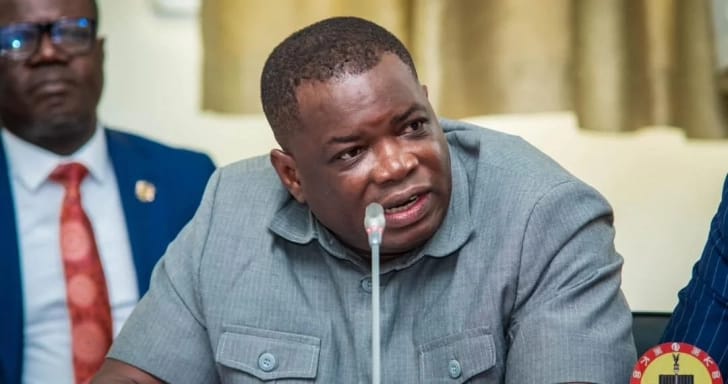
Ghana’s Minister of Roads and Highways, Kwame Governs Agbodza, has sought to quell criticism from the opposition New Patriotic Party’s Ashanti Caucus over changes to the Suame Interchange project, insisting that the redesign represents a more efficient and less costly solution for Kumasi’s growing infrastructure needs.
The project, originally envisioned as a four-tier interchange, has been scaled back to three tiers. Mr. Agbodza rejected claims that the government was compromising with a “two-tier” design, saying instead that the elimination of the fourth bridge was a deliberate choice to avoid excessive demolitions and spiraling compensation costs.
“The Suame Interchange is being modified in light of new developments within the greater Kumasi environs,” the minister said, adding that the current plan “offers a superior solution with fewer demolitions and an increased total length of new roads.”
Officials estimate that compensation and utility relocation costs under the original design would have consumed more than half of the project’s construction budget. The fourth-tier bridge, in particular, would have required the removal of major landmarks, including the Garden City Mall, the Suame Police Station, and several commercial properties.
Mr. Agbodza pointed to the government’s “Big Push” program, which includes the construction of the Kumasi Outer Ring Road from Boankra to Akom. That new route, he said, will divert heavy north–south traffic away from Kumasi’s center, reducing the capacity demands on the Suame intersection and making the three-tier design more practical.
The minister also dismissed suggestions that funds were being siphoned away from the project. He said more than GH¢3 billion has been committed to the surrounding road network, including rehabilitation of the N10 from Abusuakuruwa to Akom. The government is also completing the Inner Ring Road from Asokwa to Sofoline, part of a broader effort to strengthen Kumasi’s transport system.
“The decision is not about cutting corners,” Mr. Agbodza said. “It is about ensuring value for money and delivering infrastructure that meets the city’s needs without unnecessary destruction.”
The Suame Interchange, long seen as a centerpiece of Kumasi’s modernization, has become a flashpoint in Ghana’s infrastructure debate. For the government, the redesign is a pragmatic adjustment to shifting traffic patterns and fiscal realities. For critics, it is a retreat from ambition.