

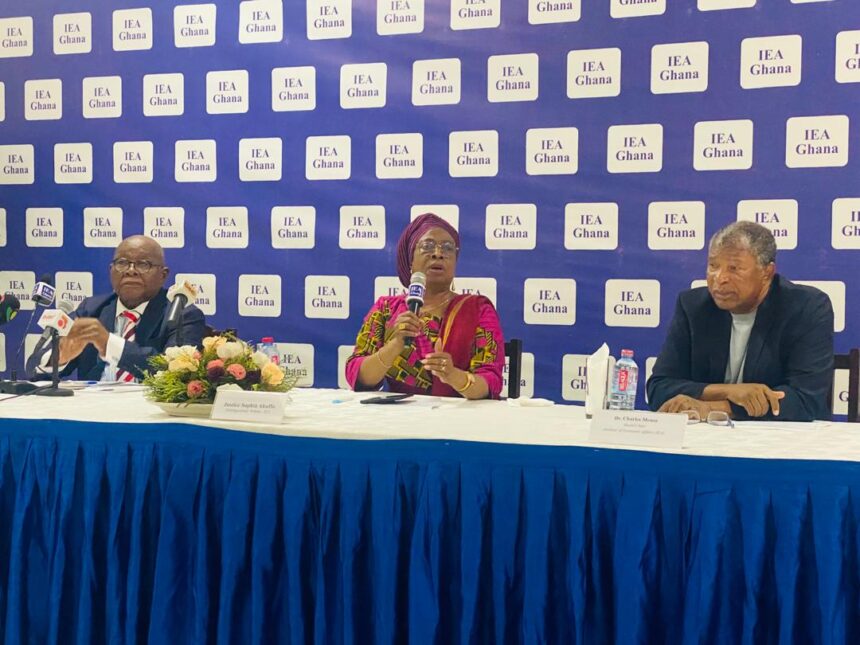
The Institute of Economic Affairs (IEA) has strongly rejected the Lands and Natural Resources Minister’s proposed sliding-scale mineral royalty regime contained in the draft Minerals and Mining (Royalty) Regulations, 2025, currently before Parliament.
According to the IEA, the proposed framework, which sets royalties between 5% and 12% for minerals such as gold and lithium, merely repackages what it describes as an outdated, colonial-era royalty system that continues to transfer ownership and value of Ghana’s natural resources to foreign interests.
“Ghana’s prevailing royalty-based model for natural resource governance is unacceptable and must be replaced with modern frameworks that ensure full national ownership for the good of Ghana.” — IEA.
The think tank expressed further concern over a Reuters publication dated January 15, 2026, which quoted the Acting CEO of the Minerals Commission, Isaac Tandoh, as indicating that the government is considering a 9%–12% sliding-scale royalty regime across the mining sector.
The IEA described the position as confounding and contradictory to President John Mahama’s publicly stated stance on resource sovereignty.
Referencing the President’s keynote address at the National Economic Dialogue in March 2025, the IEA recalled his agreement with former Chief Justice Sophia Akuffo, who described Ghana’s mining agreements as relics of the “Guggisberg era.”
“There must be increased indigenous participation in the exploitation of our natural resources. Ghana must earn more from its natural resource endowment.” — President John Mahama.
The IEA also cited the President’s address at the 80th UN General Assembly and his remarks at the World Economic Forum in Davos, where he warned that Ghana supplies critical minerals to the world but captures almost none of the value.
“We supply the world’s critical minerals but capture almost none of the value. This isn’t sovereignty. It is a trap.” — President John Mahama, Davos 2026
The Institute argues that while the President has clearly moved toward a reform agenda anchored in state ownership and service contracts, the Minister’s proposal reflects what it calls a colonial mindset that continues to export Ghana’s wealth.
“The President is ahead of his Ministers.” — IEA.
The IEA insists Ghana has the technical expertise, capital options, and human resources to manage its own minerals, pointing to successful examples from Norway, Botswana, Chile, Burkina Faso, Mali, Niger, and OPEC countries, where strong state participation has driven economic transformation and poverty reduction.
“Technology can be purchased. Expertise exists. What has been lacking is the political will.” — IEA.
In its conclusion, the IEA urged governments not to renew expiring mining leases but instead adopt a new ownership model based on national control and service contracts, warning that continued reliance on royalties will only deepen economic dependency.
“What if we exercised more sovereignty over our natural resources to create prosperity for our people?”
By Nana Achia Aboagye