


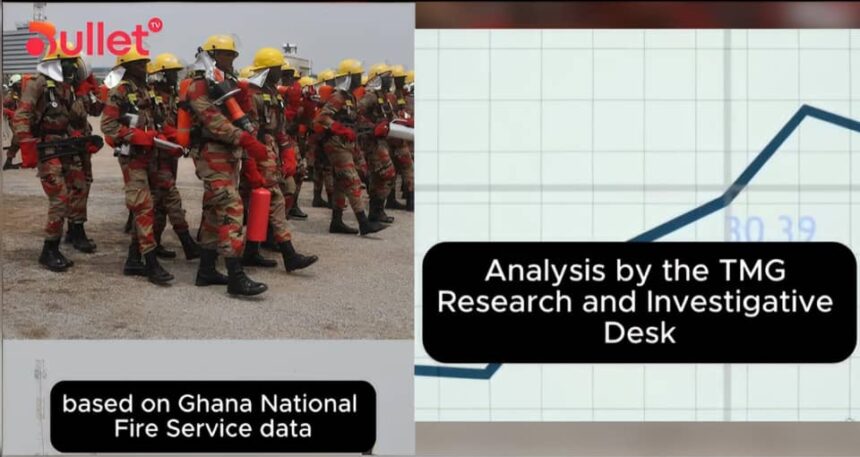
2020 remains Ghana’s worst year on record for fire outbreaks, with more than 16,500 incidents reported nationwide, making it a historic outlier in fire statistics.
Although the number of incidents has declined in subsequent years, casualties and economic losses continue to rise, raising serious public safety concerns.
An analysis by the Tobinco Media Group (TMG) Research and Investigative Desk, based on data from the Ghana National Fire Service (GNFS), shows a clear downward trend in fire outbreaks since 2020—largely attributed to intensified public education, safety campaigns, and improved emergency response awareness.
After the 2020 peak:
-2023 recorded approximately 6,000 fire incidents
-2024 saw a slight increase to about 6,434 cases
-2025 recorded a marginal decline to 5,585 cases (between January and November)
Preliminary figures for early 2026 remain general and incomplete, but the GNFS projects a significant reduction by the end of the year, pending sustained public compliance with fire safety regulations.
Domestic Fires Remain the Leading Cause
Despite the overall decline, domestic fires continue to dominate, accounting for approximately 37 to 41 percent of all reported incidents annually. These fires are often linked to faulty electrical wiring, gas leaks, unattended cooking, and poor housing layouts—especially in densely populated urban areas.
The Alarming Trend: Rising Casualties
While incidents have reduced numerically, the severity of fires has increased, leading to higher casualty figures and greater property losses. Fire officers cite congestion, poor access routes, illegal structures, and delayed emergency reporting as key factors worsening outcomes when fires occur.
The Bigger Picture
The data paints a mixed picture: progress in prevention, but persistent structural and enforcement challenges. Experts warn that without improved urban planning, stricter enforcement of building codes, and continued public education, the human cost of fires may continue to rise—even if incident numbers fall.