

The National Labour Commission (NLC) has declared an intended strike by the Ghana Air Traffic Safety Electronics Association (GhATSEA) illegal, ordering its immediate suspension.
The directive, issued after a meeting on Wednesday, January 14, 2026, with the Ghana Civil Aviation Authority (GCAA) and GhATSEA representatives, underscored that the association lacks the legal standing to declare or institute industrial action.
“GhATSEA is an association and not a registered union recognized to negotiate or undertake industrial action,” the Commission ruled, citing provisions under Regulation 20(e) and (h) of the Labour Regulations, L.I. 1833.
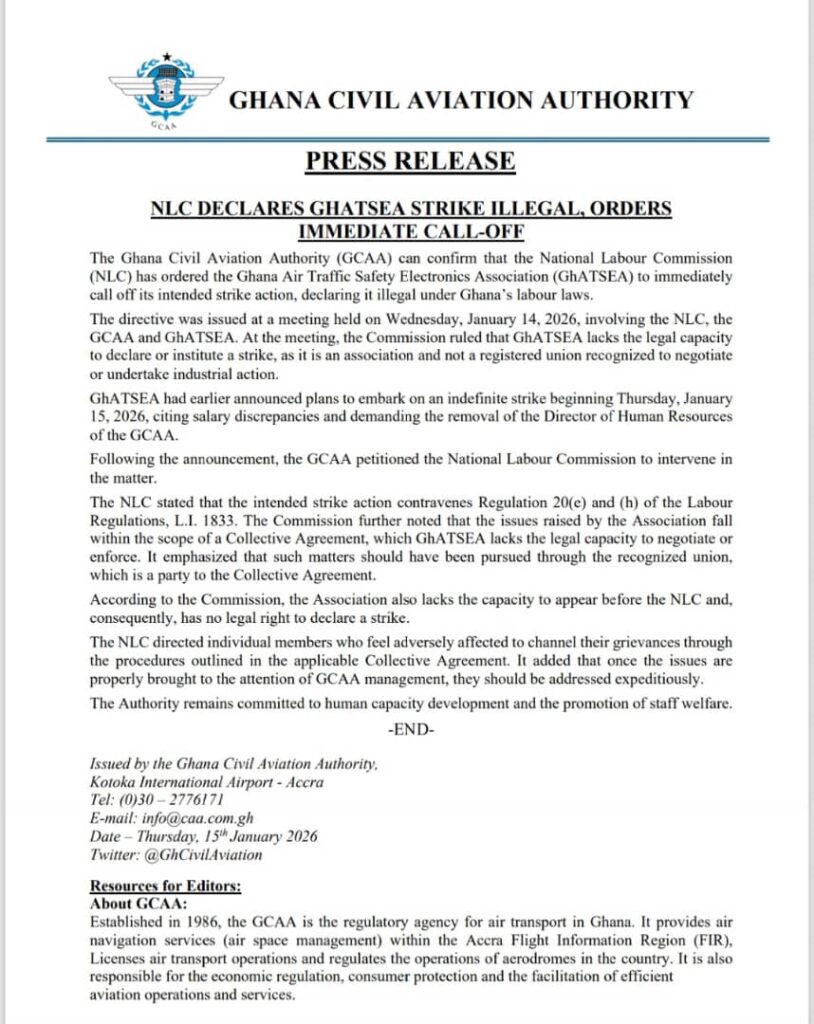
GhATSEA had earlier announced plans to embark on an indefinite strike beginning Thursday, January 15, citing salary discrepancies and demanding the removal of the GCAA’s Director of Human Resources. The GCAA petitioned the NLC to intervene, warning of potential disruptions to aviation operations.
The Commission emphasized that the grievances raised fall within the scope of a Collective Agreement, which GhATSEA is not legally empowered to negotiate or enforce. “Such matters should have been pursued through the recognized union, which is a party to the Collective Agreement,” the NLC noted.
In its ruling, the Commission further stated that GhATSEA “lacks the capacity to appear before the NLC and, consequently, has no legal right to declare a strike.”
Individual members who feel adversely affected were advised to channel their complaints through established procedures. The Commission added that once grievances are properly submitted, GCAA management should address them “expeditiously.”
The GCAA, in a statement, reaffirmed its commitment to staff welfare and professional development, saying it “remains committed to human capacity development and the promotion of staff welfare.”