


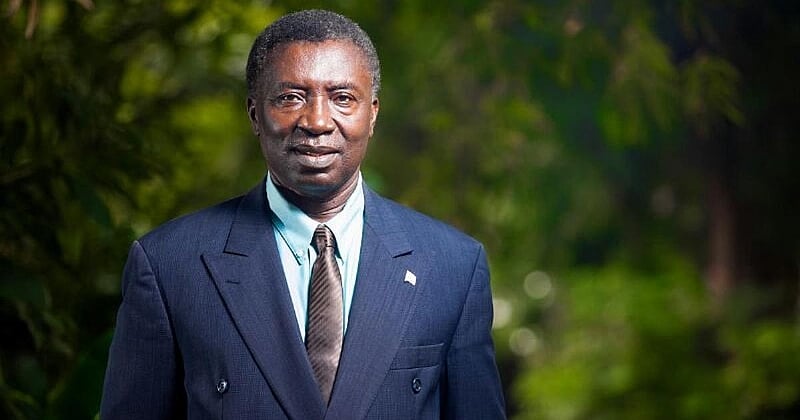
Renowned cardiothoracic surgeon and former Minister of Environment, Science, Technology and Innovation, has urged Ghana to raise its surgical standards to match global benchmarks, warning that inadequate facilities, outdated equipment, and limited investment in specialist training continue to hold the country back.
Speaking on Accra based Channel One TV’s The Point of View on Monday, January 12, Frimpong-Boateng lamented that many complex procedures are still performed abroad because Ghana lacks the infrastructure to handle them.
“It has not grown that much; there has not been adequate investment in equipment and training,” he said. “Training is very important. We have to train people all the time for the next generation, but that has been lagging.” He said.
The surgeon, who pioneered Ghana’s National Cardiothoracic Centre, noted that capacity in cardiac surgery has barely expanded over the years. He attributed the stagnation to insufficient investment in both technology and human resource development. While some private hospitals boast strong diagnostic capabilities, he said, only a handful of centers are equipped to carry out advanced surgical procedures.
“There are private hospitals in Ghana that do diagnostics, but there are only a few centres that are able to do the surgery,” he observed. “We’re hoping that some bold private people will get involved. We need equipment. Things are growing very fast and developing very fast, and we need to be abreast with the times.”
Frimpong-Boateng rejected comparisons that measure Ghana’s surgical performance against regional peers, insisting that the country must aim higher. “I don’t like things like we’re good in West Africa, Africa, we’re good in South of the Sahara,” he said. “No, if we’re good, we should be at par with the rest of the world. We cannot do a transplant of the heart; the lungs. We cannot do certain things in the heart. We do pediatric cases, but some are sent outside.”
He pointed to the National Cardiothoracic Centre at Korle-Bu Teaching Hospital as an example of the strain on existing facilities, describing it as too small to meet growing demand. He expressed optimism that the University of Ghana Medical Centre, once fully operational, could help ease the pressure. “We need to expand the facility, Korle-Bu; the cardio centre is too small. The University of Ghana Medical Centre is coming up, and I hope that it will absorb some of the pressures,” he said.
Despite the challenges, Frimpong-Boateng emphasized that Ghana has no shortage of motivated and intelligent professionals. What is lacking, he argued, is leadership and strategic investment to ensure the country keeps pace with rapid global advancements in medical technology. “Somebody must be there to lead and train and get the equipment there so that we can be abreast with the rest of the world,” he said.