

Ghana’s foreign minister, Samuel Okudzeto Ablakwa, has formally urged Britain to exempt Ghanaian students and professionals from the International English Language Testing System (IELTS) and its associated fees, arguing that the requirement is unnecessary given the country’s long-standing use of English as its medium of instruction.
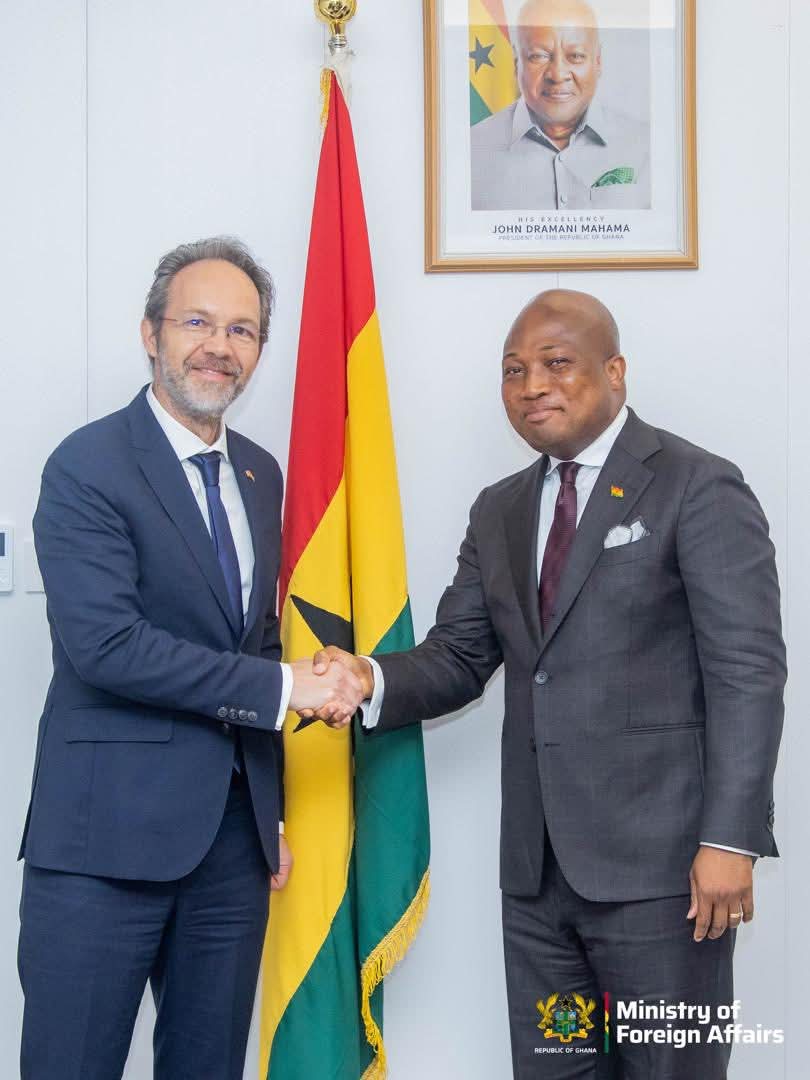
The appeal was made Tuesday during a meeting with the British High Commissioner to Ghana, Christian Rogg, at the Ministry of Foreign Affairs. The talks, officials said, were part of broader efforts to deepen Ghana-U.K. relations, with discussions spanning security, trade, job creation, health, education, governance and constitutional review.
“We called for Ghana to be exempted from the IELTS and the fees payable by Ghanaian students and professionals since English has long been the medium of instruction in Ghana,” Mr. Ablakwa said after the meeting.
The request comes as Ghana seeks to elevate its ties with Britain to a strategic partnership, with particular emphasis on frameworks to safeguard and improve conditions for Ghanaian health practitioners working abroad. The issue of language testing has become a point of contention for many in Ghana, who see the requirement as redundant and burdensome.
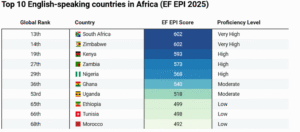
Meanwhile, Ghana’s standing in global English proficiency rankings appears to bolster its case. The country was ranked sixth in Africa and 36th worldwide in the 2025 Education First English Proficiency Index, which assessed data from more than 2.2 million participants across 123 regions. Ghana placed behind South Africa and Zimbabwe, which jointly topped the continent at 13th globally, as well as Kenya (19th), Zambia (27th) and Nigeria (29th). Still, it outperformed several African peers, including Uganda (53rd), Ethiopia (65th), Tunisia (66th), Morocco (68th) and Tanzania (77th).
EF categorises countries into five proficiency bands: Very High, High, Moderate, Low and Very Low, providing a comparative snapshot of how effectively populations can use English in professional, academic and social contexts. Southern and East African nations, notably South Africa and Zimbabwe, were the only ones to achieve “Very High” proficiency on the continent.
The index demonstrates the importance of English proficiency in driving business, attracting investment and enhancing global trade connectivity. The annual index assesses adult English language skills across 123 countries and territories worldwide, drawing on results from more than 2.2 million test takers who completed the EF Standard English Test (EF SET), the world’s largest free standardised English assessment.