


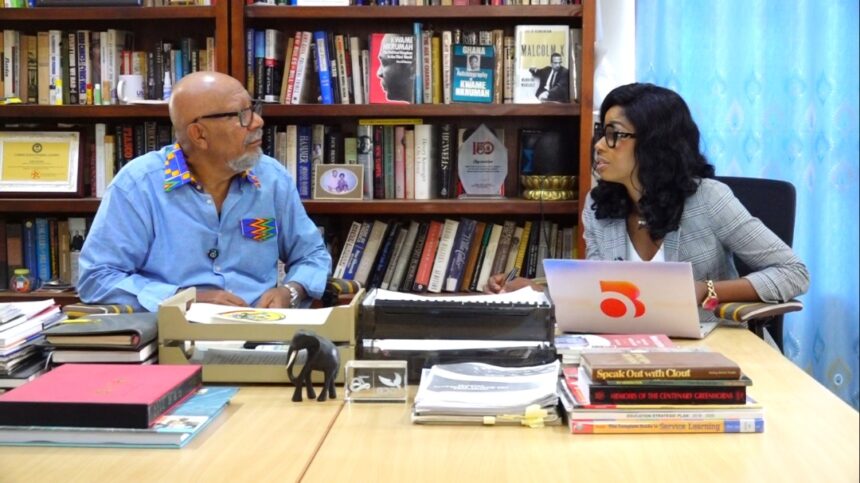
Renowned educationist and Founder of the Gifted and Talented Education (GATE) Institute, Anis Haffar, has called for a complete overhaul of Ghana’s examination and teaching system, describing it as outdated and incapable of producing competent learners for the modern world.
Reacting to the poor performance in the 2025 provisional WASSCE results, Mr. Haffar said the decline is alarming and should trigger a serious national reflection on Ghana’s educational priorities. He warned that the current “chew and pour” learning culture has outlived its usefulness and continues to produce graduates who struggle to apply knowledge outside the classroom.
Sharp Decline in 2025 Results
According to provisional data released by WAEC, only 55.82% of candidates obtained grades A1 to C6 in the 2025 WASSCE—a steep drop from 71.53% in 2024.
The 15.71-percentage point decline marks the country’s worst performance since 2021, when 66.03% passed.
Core Mathematics recorded the most troubling results, with more than half of the candidates failing, making it the weakest performance in seven years. Several other core subjects also saw significant declines, raising concerns about the quality of teaching and learning nationwide.
“The System Is Not Working” – Haffar
Mr. Haffar said the results should serve as a wake-up call.
“Our school system, and the WASSCE results in particular, have proven not to be working for the country. It has only succeeded in producing functional illiterates because the system causes students to acquire knowledge they cannot relate to outside the classroom.”
He argued that Ghana’s theory-heavy education model has become inimical to national development, stressing that learning must shift toward practical, hands-on experiences that develop applicable skills.
Call for a Paradigm Shift
The GATE Institute founder outlined several areas where urgent reforms are needed. If given the mandate to redesign Ghana’s education structure, he said he would prioritise:
-Technology-driven teaching and assessment
-Project-based and practical learning
-Skill development aligned with industry needs
-Reduced emphasis on high-stakes, theory-based examinations
He emphasised that global education systems are transforming rapidly, and Ghana risks being left behind if the country does not adopt similar forward-looking reforms.
Technology as a Game-Changer
Mr. Haffar highlighted technology as central to improving learning outcomes. He said integrating digital tools, simulations, and interactive platforms would modernise classroom delivery and prepare students for a digital-first global economy.
Advice to Students and Teachers
He encouraged students to cultivate critical thinking, creativity, and curiosity, rather than relying on last-minute memorisation.
Teachers, he said, must adopt modern teaching methods, embrace technology, and create practical learning experiences to bridge the gap between theory and application.
A Moment for National Reflection
The disappointing 2025 WASSCE performance has reignited urgent conversations about the state of Ghana’s education system. As stakeholders debate the implications, one question remains:
Will Ghana commit to transforming its theory-heavy curriculum into a practical, skills-based system capable of producing graduates who can compete globally?
Many experts, including Mr. Haffar, believe this moment presents an opportunity for Ghana to re-engineer its education model for long-term growth and competitiveness.
By Nana Achiaa Aboagye