


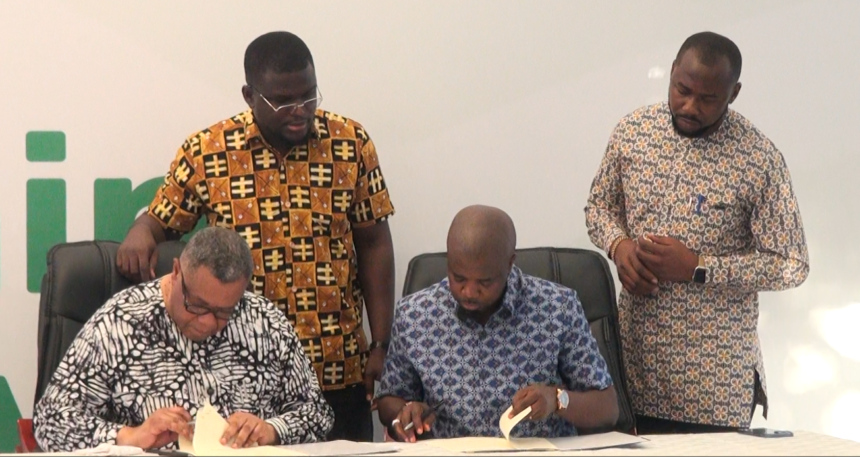
The 24-Hour Economy Authority and the National Petroleum Authority (NPA) have signed a Memorandum of Understanding to support the expansion of 24-hour operations across Ghana’s downstream petroleum sector.
The agreement, signed on March 31, 2026, at the office of the 24-hour economy authority, forms part of efforts to advance the country’s broader economic transformation agenda through a reliable, round-the-clock fuel supply.
Chief Executive of the National Petroleum Authority, Godwin Edudzi Tamakloe, said the authority is confident that adopting a 24-hour petroleum economy in the downstream sector will create thousands of employment opportunities.
“Adopting a 24-hour economy in the petroleum downstream would improve the availability and accessibility of petroleum products nationwide, enhance efficiency and reliability in the supply and distribution chain, create thousands of direct and indirect employment opportunities, and boost economic revenue, government revenue, and stimulate economic growth,” Mr. Edudzi Tamakloe noted.
Under the terms of the MoU, the NPA will develop and enforce operational readiness standards for 24-hour service delivery across fuel stations, refineries, bulk storage depots, and bulk road vehicle operations.
The 24-Hour Economy Authority, on the other hand, will coordinate the enabling environment, including the deployment of security agencies and cross-government support for certified operators.
Presidential Adviser on the 24-Hour Economy and Accelerated Export Development, Augustus Goosie Tanoh, explained that “the NPA will set the standards for safe round-the-clock operations, lighting, security, staffing, and digital monitoring.”
He added, the 24-hour authority “will coordinate the enabling environment, working with security agencies and other relevant bodies to ensure that operators who meet the standards are supported, and this is important.
Compliance, standards, support, and the overall support of the security services and the NPA in the context of the compliance requirements of the NPA.”
Implementation of the initiative will begin with a nationwide pilot covering about 10 percent of the downstream sector.
Deputy Minister for the Ministry of Energy and Green Transition, Richard Gyan-Mensah, reiterated the ministry’s commitment to ensuring that President Mahama’s vision is realized.
Honourable Richard Gyan-Mensah said, “As a ministry, we strongly support the 24-hour economy, its implementation, and we deem it fit that all agencies, not just NPA, come out with a roadmap, if all the other agencies also join.
And I believe agencies like TOR (Tema Oil Refinery) have already started, but we want the full roadmap that they have. We know BOST is also working around it, and some of the agencies as well.”
The NPA has already set up a Steering Committee and technical sub-committees to oversee preparations for the transition.
Source: Job Kwabena Laboja and Mavis Fantevi